


2024 Easy Success Cisco 300-510 Exam in First Try
Best 300-510 Exam Dumps for the Preparation of Latest Exam Questions
Cisco 300-510 exam is designed for professionals who want to enhance their knowledge in implementing advanced routing solutions in a service provider network. 300-510 exam covers a wide range of topics, including network services, routing protocols, and network security. Passing 300-510 exam is a great way to demonstrate your expertise in this field, and it can help you advance your career in the networking industry.
NEW QUESTION # 60
Refer to the exhibit. A network operator is working to filter routes from being advertised that are covered under an aggregate announcement.
The receiving router of the aggregate announcement block is still getting some of the more specific routes plus the aggregate.
Which configuration change ensures that only the aggregate is announced now and in the future if other networks are to be added?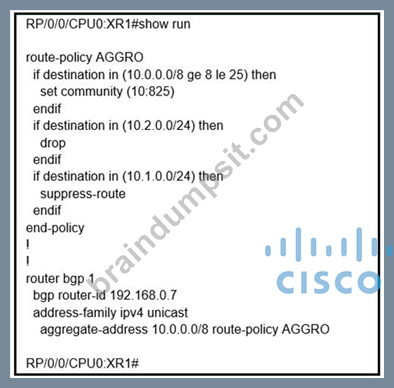
- A. Set each specific route in the AGGRO policy to remove instead of suppress-route
- B. Filter the routes on the receiving router
- C. Configure the summary-only keyword on the aggregate command
- D. Set each specific route in the AGGRO policy to drop instead of suppress-route
Answer: C
NEW QUESTION # 61
Refer to the exhibit.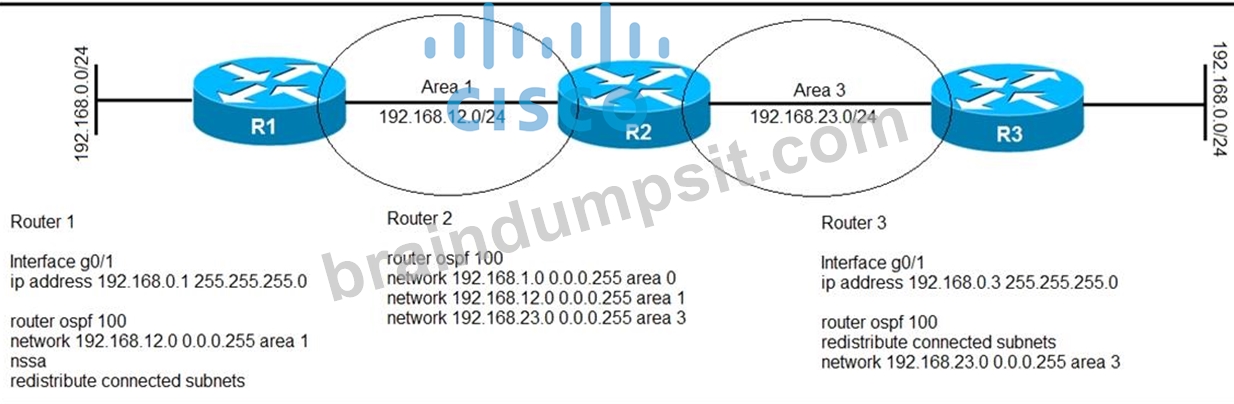
After troubleshooting an OSPF adjacency issue, routers 1, 2, and 3 have formed OSPF neighbor relationships. Which statement about the configuration is true?
- A. Router 2 uses router 1 as the next hop for 192.168.0.0/24
- B. Router 2 uses router 3 as the next hop for 192.168.0.0/24
- C. Router 2 receives a Type 5 LSAs from router 1 for its connected subnets
- D. Router 2 receives a Type 7 LSAs from router 3 for its connected subnets
Answer: C
NEW QUESTION # 62
The operator must leverage automated steering and coloring with the design. Which two elements from an SR Policy tuple are used for automated steering inside of the network?
(Choose two.)
- A. headend
- B. CM paths
- C. endpoint
- D. color
- E. candidate labels
Answer: C,D
NEW QUESTION # 63
Drag and Drop Question
Drag and drop the features from the left onto the corresponding routing protocols on the right.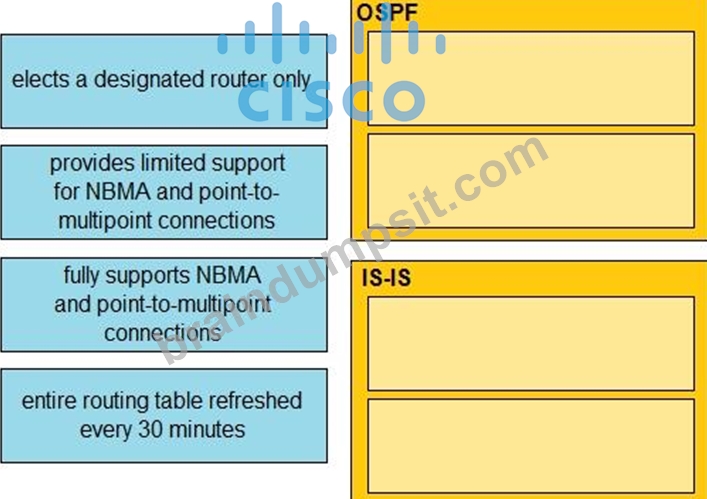
Answer:
Explanation: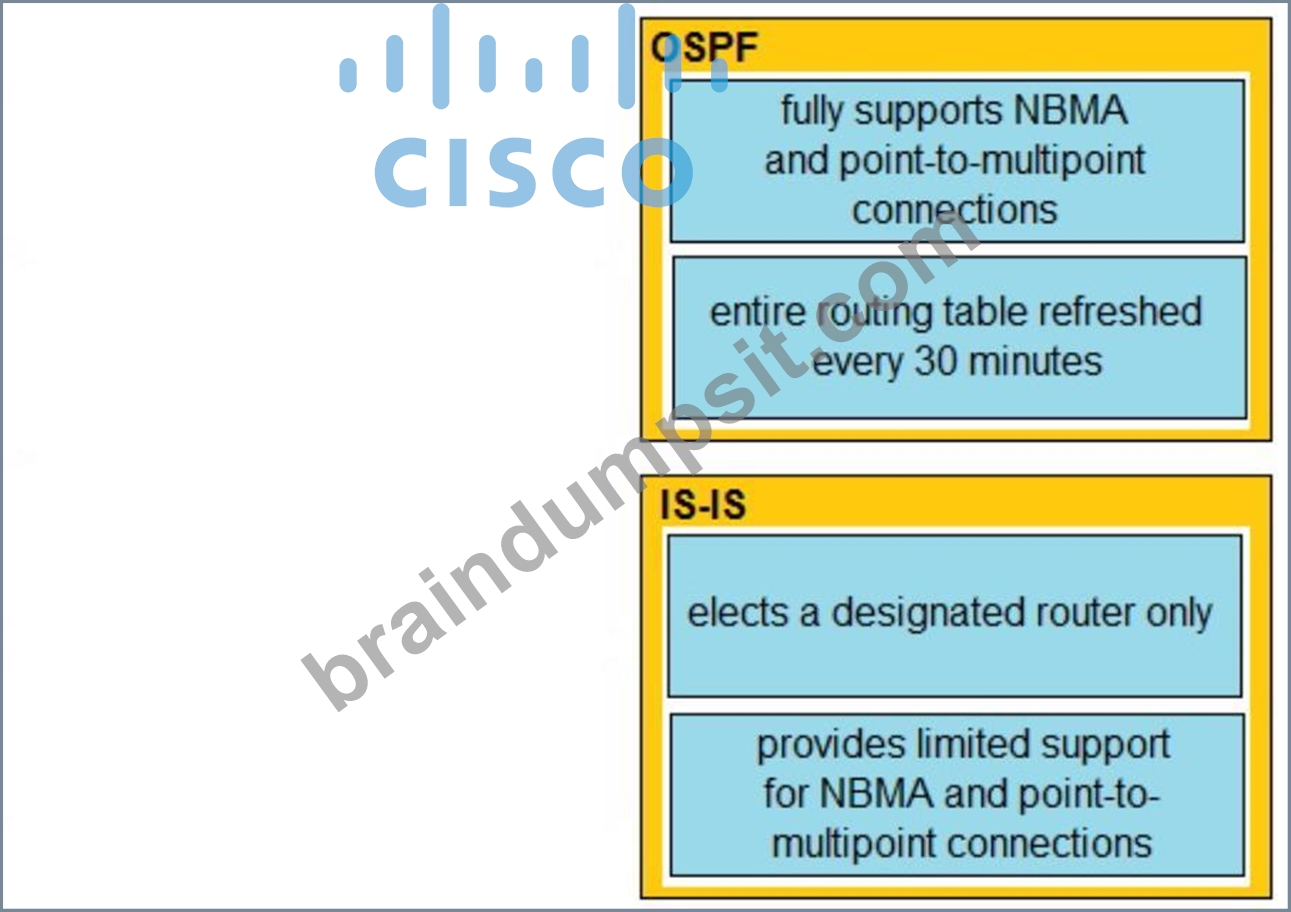
NEW QUESTION # 64
A network engineer must configure a Cisco IOS XR router with BGP dampening.
Which configuration meets these parameters?
- A. router bgp 60
address-family ipv4 unicast
bgp dampening - B. router bgp 60
neighbor 10.0.0.2
bgp dampening - C. route-policy dampening_specific
drop
!
router bgp 60
address-family ipv4 unicast
bgp dampening route-policy dampening_specific - D. router bgp 60
address-family ipv4
bgp dampening - E. router bgp 60
bgp dampening
Answer: A
NEW QUESTION # 65
Refer to the exhibit.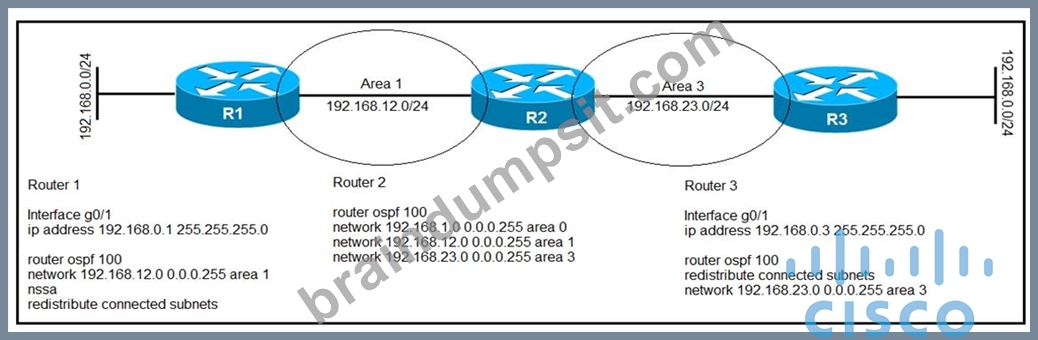
After troubleshooting an OSPF adjacency issue, routers 1, 2, and 3 have formed OSPF neighbor relationships. Which statement about the configuration is true?
- A. Router 2 uses router 3 as the next hop for 192.168.0.0/24
- B. Router 2 uses router 1 as the next hop for 192.168.0.0/24
- C. Router 2 receives a Type 7 LSAs from router 3 for its connected subnets
- D. Router 2 receives a Type 5 LSAs from router 1 for its connected subnets
Answer: B
Explanation:
From IOS 15.1(2)S onwards, Cisco uses the OSPF path selection order is O > O IA > N1 > E1 > N2 > E2 https://www.cisco.com/c/en/us/support/docs/ip/open-shortest-path-first-ospf/212608-ospf-external-path-selection-external-t.html
NEW QUESTION # 66
Refer to the exhibit.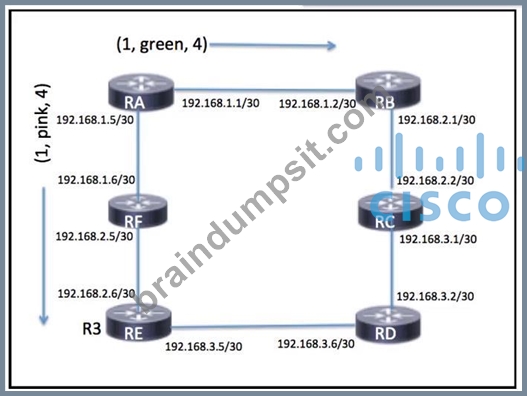
The green policy is designed with low delay, and the pink policy is designed with low cost. What is the next hop for node A on its way to node D, with the objective of achieving a low delay?
- A. 192.168.3.2
- B. 192.168.1.6
- C. 192. 168.1.2
- D. 192.168.3.6
Answer: C
NEW QUESTION # 67
SIMULATION
Guidelines
This is a lab item in which tasks will be performed on virtual devices.
- Refer to the Tasks tab to view the tasks for this lab item.
- Refer to the Topology tab to access the device console(s) and perform the tasks.
- Console access is available for all required devices by clicking the device icon or using the tab(s) above the console window.
- All necessary preconfigurations have been applied.
- Do not change the enable password or hostname for any device.
- Save your configurations to NVRAM before moving to the next item.
- Click Next at the bottom of the screen to submit this lab and move to the next question.
- When Next is clicked, the lab closes and cannot be reopened.
Topology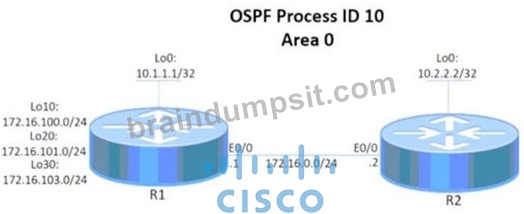
Tasks
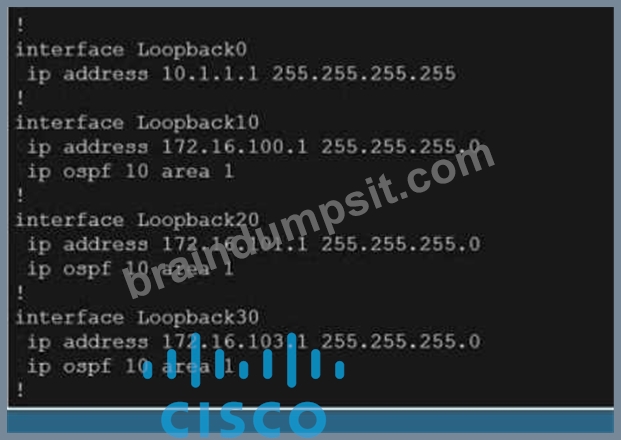
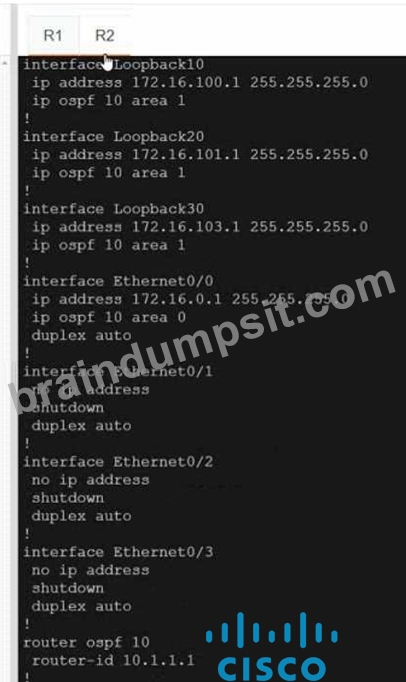
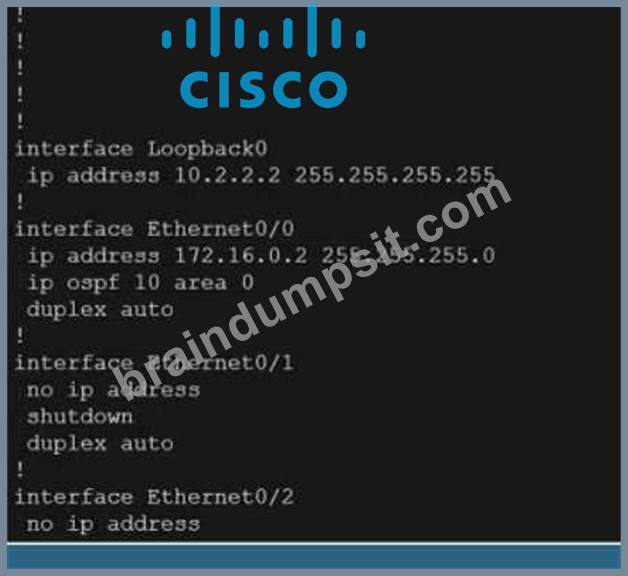
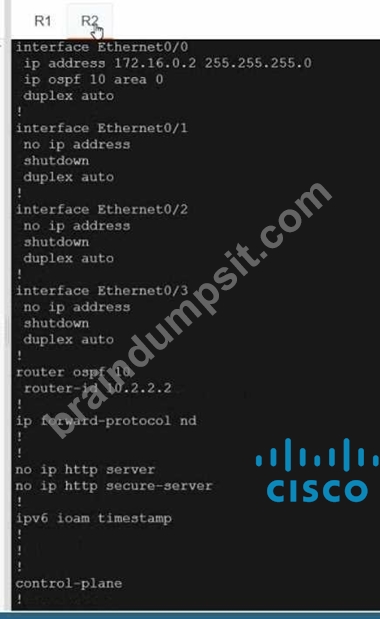
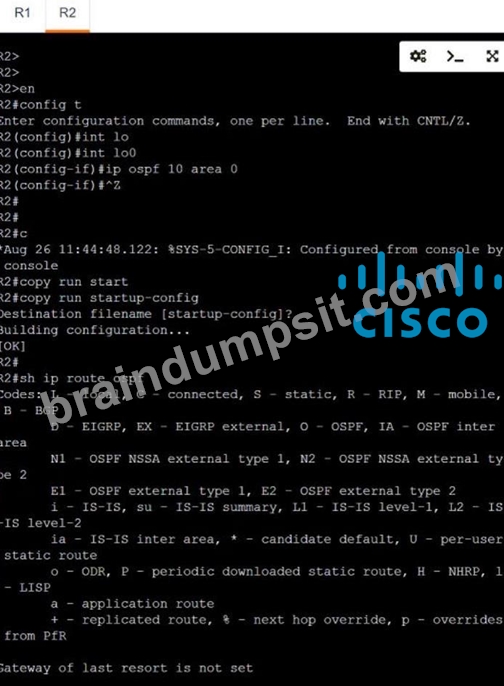
Configure and verify an OSPF neighbor adjacency between R1 and R2 in OSPF area 0 according to the topology to achieve these goals:
1. R1 pings the Loopback0 interface of R2. Use interface-level configuration to complete this task.
2. R2 pings the Loopback0 interface of R1. Use interface-level configuration to complete this task.
3. R2 receives a single summary route 172.16.100.0/22 for networks 172.16.100.0/24,
172.16.101.0/24, and 172.16.103.0/24.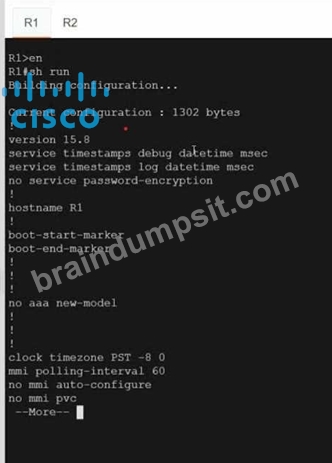
Answer:
Explanation: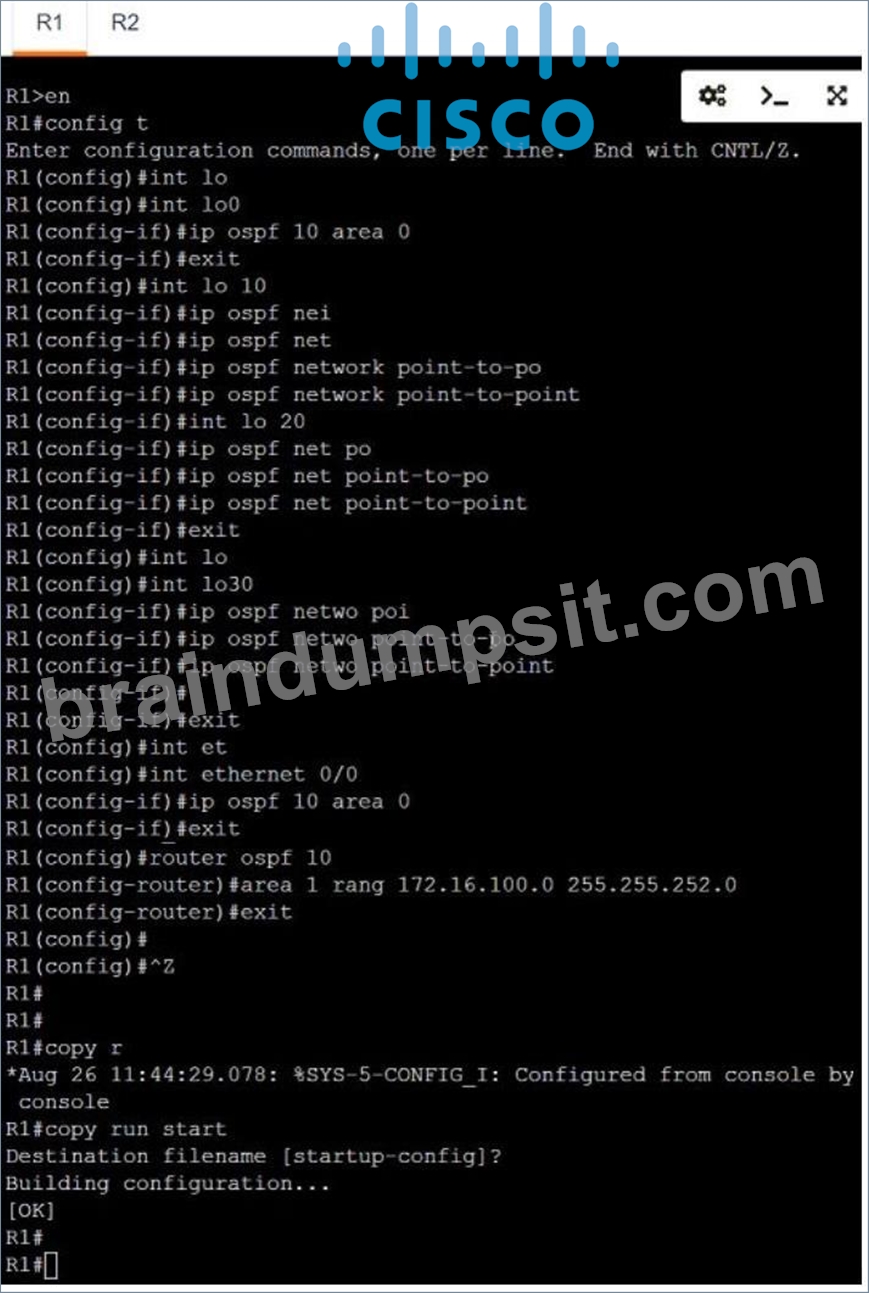
NEW QUESTION # 68
Refer to the exhibits. A network operator is troubleshooting packet loss seen from the R1 loopback interface to the R2 loopback interface over the core network. The operator is attempting to identify the next leg in the path from PE1.
Which interface and label path should the operator investigate next?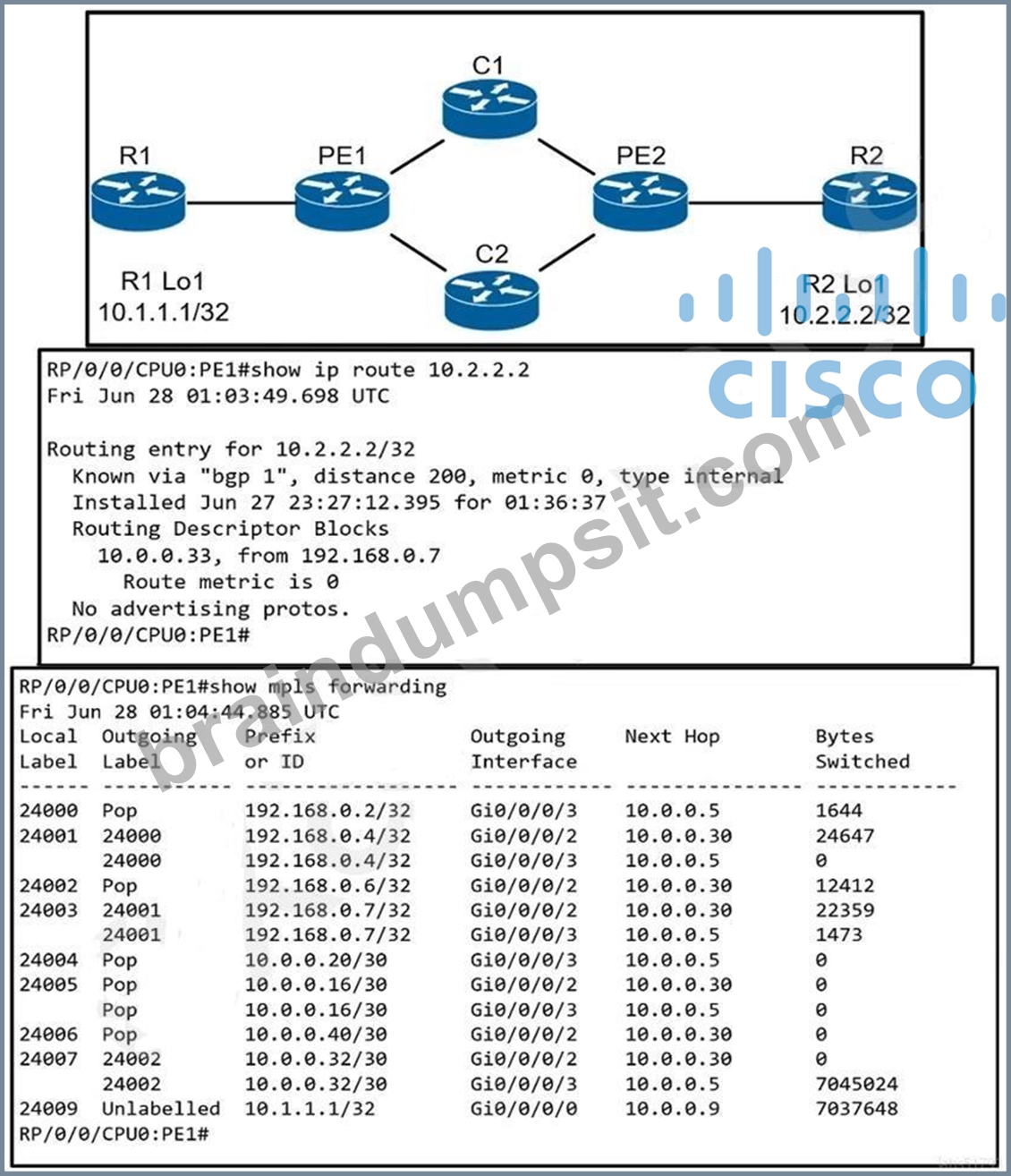
- A. PE1 - Gi0/0/0/2 - forwarding label 24001
- B. PE1 - Gi0/0/0/3 - forwarding label 24001
- C. PE1 - Gi0/0/0/2 - forwarding label 24002
- D. PE1 - Gi0/0/0/3 - forwarding label 24002
Answer: B
NEW QUESTION # 69
Refer to the exhibit. An engineer has successfully fixed BGP peering issue. R1 has an established eBGP peering with R2 and R3.
Which mechanism should the engineer apply in order to steer the traffic correctly?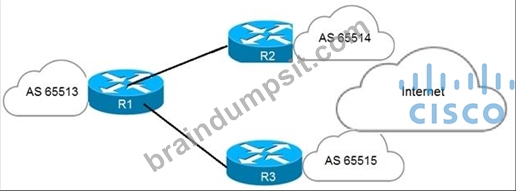
- A. The local preference attribute can be applied on R3 to influence AS 65513 to use AS 65515 as the secondary path.
- B. The IGP metric can be manipulated on R1 to allow traffic to be load balanced between R2 and R3.
- C. The MED attribute can be applied on R2 to influence R1 to use it as the primary path.
- D. The weight attribute can be applied on R2 to influence AS 65513 to use AS 65515 as the primary path.
Answer: B
NEW QUESTION # 70
Refer to the exhibit. A network operator is troubleshooting TE tunnels and discovers that the soft preemption is not working as desired.
Where should the soft preemption be applied to solve the issue?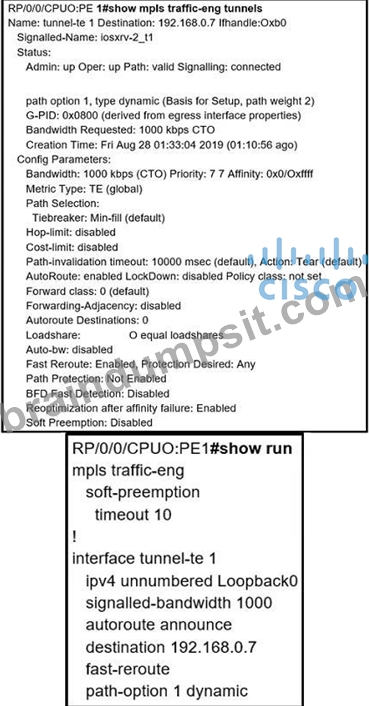
- A. under the tunnel-te1 interface on PE1
- B. on the tail-end device for tunnel-te1 192.168.0.7
- C. explicitly for tunnel-te 1 under the Cisco MPLS TE configuration mode after the timeout setting
- D. Under the interface Loopback0 necessary for this deployment type.
Answer: A
NEW QUESTION # 71
Refer to the exhibit.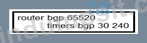
Which effect of this configuration is true?
- A. It sets the hold timer to 30 milliseconds and the keepalive timer to 240 milliseconds
- B. It sets the hold timer to 30 seconds and the keepalive timer to 240 seconds
- C. It sets the keepalive timer to 30 seconds and the hold timer to 240 seconds.
- D. It sets the keepalive timer to 30 milliseconds and the hold timer to 240 milliseconds
Answer: C
NEW QUESTION # 72
Refer to the exhibit.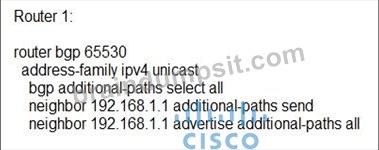
Which statement about this configuration is true?
- A. Router 1 receives up to two paths from neighbor 192.168.1.1 for all routes in the same AS
- B. Router 1 receives only the best path from neighbor 192.168.1.1
- C. Router 1 sends and receives multiple best paths from neighbor 192.168.1.1
- D. Router 1 sends up to two paths to neighbor 192.168.1.1 for all routes
Answer: C
NEW QUESTION # 73
Refer to the exhibit. A network engineer has divided AS into confederations. Due to repeated ASN, when the 10.0 0.0/8 prefix from R1 arrives to R2, BGP automatically rejects it.
What should the engineer do to fix the problem so that BGP allows that prefix on R2?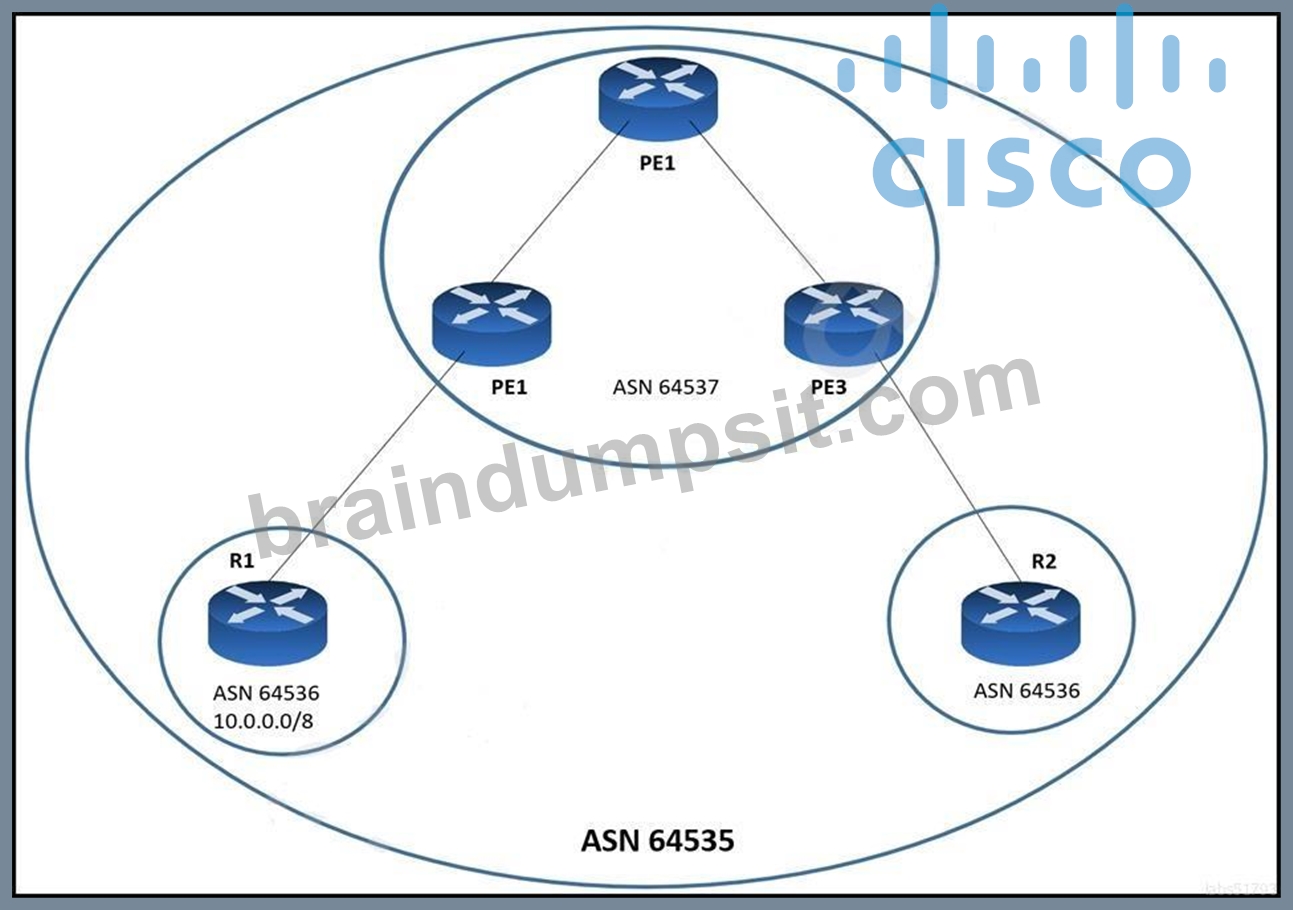
- A. Configure the command allowas-in on all the PE routers.
- B. Configure the command as-override on R1.
- C. Configure the command allowas-in on R2.
- D. Configure the command as-override on R2.
Answer: C
Explanation:
https://www.cisco.com/c/en/us/support/docs/ip/border-gateway-protocol-bgp/112236-allowas-in- bgp-config-example.html
NEW QUESTION # 74
Refer to the exhibit.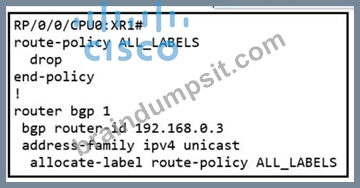
A network operator is working to deploy a Unified BGP design and allow it to be available only in selected markets and services in the future. The label allocation is not functioning as desired. Which action will fix the issue?
- A. Remove the allocate-labels command.
- B. Remove the route policy and only configure "allocate-label".
- C. Reconfigure the route-policy ALL_LABELS to pass.
- D. Reconfigure the route-policy ALL_LABELS to match all after the drop.
Answer: C
NEW QUESTION # 75
Refer to the exhibit.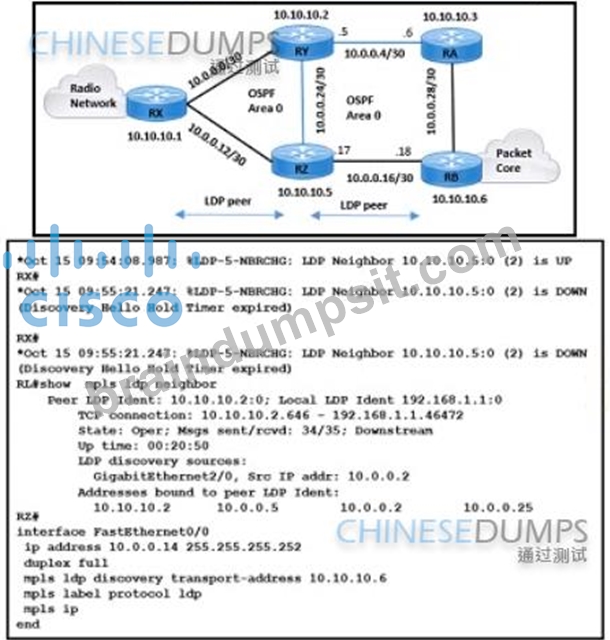
Refer to the exhibit MPLS traffic from the packet core that is connected to router RX (10 10 101) to the radio network that is connected to router RB (10 10 10 6) uses the longer route RB R2 RY RX RX and R2 are configured with a default value of LDP hello and hold intervals The team verified that OSPF neighborship in Area 0 is established between RX and R2 Which action must be taken to choose the shortest path and resolve the issue?
- A.

- B.

- C.

- D.

Answer: A
NEW QUESTION # 76
Refer to the exhibit.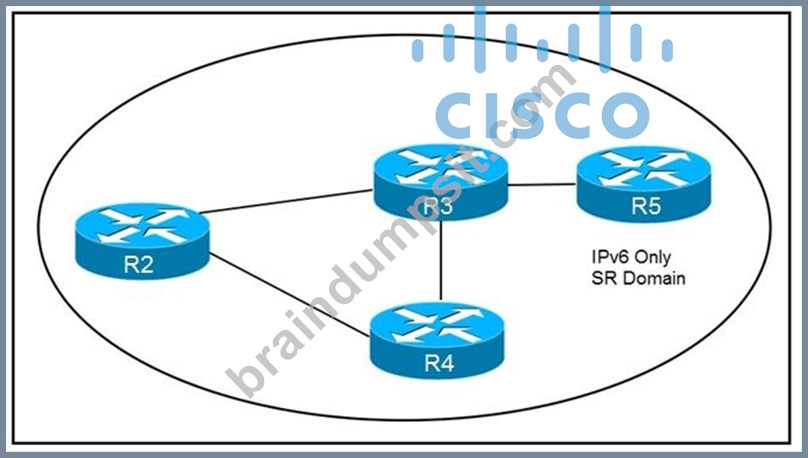
How are packets directed through the data plane when SRv6 is implemented?
- A. The MPLS data plane is used to push labels onto IGP routes
- B. An ordered list of segments is encoded in a routing extension header
- C. The packet is encapsulated with a header and trailer encoding the ordered list of segments
- D. A stack of labels represents an ordered list of segments
Answer: B
NEW QUESTION # 77
Refer to the exhibit.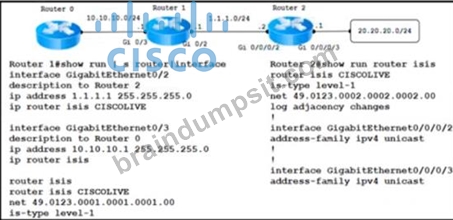
Refer to the exhibit. An engineer is troubleshooting a network routing issue on this IS-IS network situated at the customer's regional hub. Router 2 that runs Cisco IOS XR Software cannot see the network 10.1.1.0/24 on router 1. The Layer 2 encapsulations are correct. The ARP connectivity for the Ethernet interface that runs IS-IS is working. Which action resolves the issue?
- A. On router 1. add the CISCOLIVE keyword after the Ip router isis command under interface GigabitEthernet0/3.
- B. Under the router isis command on router 2. change is-type level-1 to is-type level-2
- C. Under the router isis command on router 1. change is-type level-1 to is-type level-2
- D. On router 1, remove the CISCOLIVE keyword after the Ip router Isis command under interface GigabitEthernet0/2.
Answer: A
NEW QUESTION # 78
......
300-510 Study Material, Preparation Guide and PDF Download: https://testking.braindumpsit.com/300-510-latest-dumps.html