


Pass ISA ISA-IEC-62443 Actual Free Exam Q&As Updated Dump Apr 03, 2026
Latest ISA-IEC-62443 Actual Free Exam Updated 221 Questions
NEW QUESTION # 68
Who must be included in a training and security awareness program?
Available Choices (select all choices that are correct)
- A. All personnel
- B. Vendors and suppliers
- C. Employees
- D. Temporary staff
Answer: A
Explanation:
Modbus over Ethernet, also known as Modbus/TCP, is a protocol that encapsulates the Modbus/RTU data string inside the data section of the TCP frame. It then sets up a client/server exchange between nodes, using TCP/IP addressing to establish connections1. This makes it easy to manage in a firewall, because the firewall can filter the traffic based on the source and destination IP addresses and the TCP port number. The default TCP port for Modbus/TCP is 502, but it can be changed if needed. Modbus/TCP does not use any other ports or protocols, so the firewall rules can be simple and specific. References:
* 8: Open Modbus/TCP Specification, RTA Automation, 2010.
* [9]: Modbus Application Protocol Specification V1.1b3, Modbus Organization, 2012.
NEW QUESTION # 69
Which is the PRIMARY responsibility of the network layer of the Open Systems Interconnection (OSI) model?
Available Choices (select all choices that are correct)
- A. Gives transparent transfer of data between end users
- B. Handles the physics of getting a message from one device to another
- C. Forwards packets, including routing through intermediate routers
- D. Provides the rules for framing, converting electrical signals to data
Answer: C
Explanation:
The primary responsibility of the network layer of the Open Systems Interconnection (OSI) model is to forward packets, including routing through intermediate routers. The network layer is the third layer from the bottom of the OSI model, and it is responsible for maintaining the quality of the data and passing and transmitting it from its source to its destination. The network layer also assigns logical addresses to devices, such as IP addresses, and uses various routing algorithms to determine the best path for the packets to travel.
The network layer operates on packets, which are units of data that contain the source and destination addresses, as well as the payload. The network layer forwards packets from one node to another, using routers to switch packets between different networks. The network layer also handles host-to-host delivery, which means that it ensures that the packets reach the correct destination host.
The other choices are not correct because:
* B. Gives transparent transfer of data between end users. This is the responsibility of the transport layer, which is the fourth layer from the bottom of the OSI model. The transport layer provides reliable and error-free data transfer between end users, using protocols such as TCP and UDP. The transport layer operates on segments, which are units of data that contain the source and destination port numbers, as well as the payload. The transport layer also handles flow control, congestion control, and multiplexing.
* C. Provides the rules for framing, converting electrical signals to data. This is the responsibility of the data link layer, which is the second layer from the bottom of the OSI model. The data link layer provides the means for transferring data between adjacent nodes on a network, using protocols such as Ethernet and WiFi. The data link layer operates on frames, which are units of data that contain the source and destination MAC addresses, as well as the payload. The data link layer also handles error detection, error correction, and media access control.
* D. Handles the physics of getting a message from one device to another. This is the responsibility of the physical layer, which is the lowest layer of the OSI model. The physical layer provides the means for transmitting bits over a physical medium, such as copper wire, fiber optic cable, or radio waves. The physical layer operates on bits, which are the smallest units of data that can be either 0 or 1. The physical layer also handles modulation, demodulation, encoding, decoding, and synchronization.
References:
* The OSI Model - The 7 Layers of Networking Explained in Plain English1
* Network Layer in OSI Model2
* OSI model3
NEW QUESTION # 70
Which layer specifies the rules for Modbus Application Protocol
Available Choices (select all choices that are correct)
- A. Data link layer
- B. Application layer
- C. Presentation layer
- D. Session layer
Answer: B
NEW QUESTION # 71
What is the definition of "defense in depth" when referring to
Available Choices (select all choices that are correct)
- A. Applying multiple countermeasures in a layered or stepwise manner
- B. Using countermeasures that have intrinsic technical depth.
- C. Aligning all resources to provide a broad technical gauntlet
- D. Requiring a minimum distance requirement between security assets
Answer: A
NEW QUESTION # 72
At Layer 4 of the Open Systems Interconnection (OSI) model, what identifies the application that will handle a packet inside a host?
Available Choices (select all choices that are correct)
- A. ATCP/UDP port number
- B. ATCP/UDP registry number
- C. ATCP/UDP application ID
- D. A TCP/UDP host ID
Answer: A
Explanation:
At layer 4 of the OSI model, also known as the transport layer, the application that will handle a packet inside a host is identified by a TCP/UDP port number. A port number is a 16-bit integer that is assigned to a specific application or service that runs on a host. Port numbers are used to multiplex and demultiplex the data streams that are exchanged between hosts and end systems. Multiplexing is the process of combining multiple data streams into one, while demultiplexing is the process of separating one data stream into multiple ones. Port numbers are part of the header of the transport layer protocol data unit (PDU), which is called a segment for TCP and a datagram for UDP. The header contains the source port number and the destination port number, which indicate the applications that are involved in the communication. For example, if a host sends a packet to another host using the HTTP protocol, which runs on port 80 by default, the source port number would be a random number chosen by the sender, and the destination port number would be 80. The receiver would then use the destination port number to demultiplex the packet and deliver it to the HTTP application.
Port numbers are divided into three ranges: well-known ports (0-1023), registered ports (1024-49151), and dynamic or private ports (49152-65535). Well-known ports are reserved for common and standardized applications and services, such as HTTP (80), FTP (21), and SSH (22). Registered ports are assigned by the Internet Assigned Numbers Authority (IANA) to specific applications and services that request them, such as Skype (49175) and Minecraft (25565). Dynamic or private ports are not assigned by any authority and can be used by any application or service that needs them, such as ephemeral ports that are used for temporary connections.
The other options are not valid identifiers for the application that will handle a packet inside a host at layer 4 of the OSI model. A TCP/UDP application ID is not a term that is used in the OSI model or the TCP/IP model.
A TCP/UDP host ID is not a term that is used in the OSI model or the TCP/IP model, and it would be more appropriate for layer 3, which is the network layer, where the host is identified by an IP address. A TCP/UDP registry number is not a term that is used in the OSI model or the TCP/IP model, and it would be more appropriate for layer 5, which is the session layer, where the registry number is used to identify a session between two hosts.
References:
* Transport Layer | Layer 4 | The OSI-Model1
* OSI model - Wikipedia2
* What is Layer 4 of the OSI Model? | Glossary | A10 Networks3
* What Are the 7 Layers of the OSI Model? | Webopedia4
NEW QUESTION # 73
Electronic security, as defined in ANSI/ISA-99.00.01:2007. includes which of the following?
Available Choices (select all choices that are correct)
- A. Computers, networks, operating systems, applications, and other programmable configurable components of the system
- B. Personnel, policies, and procedures related to the security of computers, networks. PLCs, and other programmable configurable components of the system
- C. Security guidelines for the proper configuration of IACS PLCs and other programmable configurable components of the system
- D. Security guidelines for the proper configuration of IACS computers and operating systems
Answer: A,B
Explanation:
In ANSI/ISA-99.00.01:2007, which is part of the ISA/IEC 62443 standards, electronic security encompasses both the technical and human aspects of cybersecurity within industrial automated and control systems (IACS). Option B correctly highlights components such as computers, networks, operating systems, applications, and other programmable configurable components which are intrinsic to the system's electronic security framework. Option C is also correct as it includes the personnel, policies, andprocedures which play a crucial role in securing these systems. This emphasizes that security is not only about the technological solutions but also about managing human elements and organizational processes effectively.ISA/IEC 62443 Cybersecurity Fundamentals References:
* ISA/IEC 62443 standards focus on the holistic nature of security which is clearly supported by including both the technological (Option B) and human elements (Option C) in the definition of electronic security.
NEW QUESTION # 74
Which model describes relationships between assets within an industrial automation and control system?
- A. Zone model
- B. Security level model
- C. Reference architecture
- D. Asset model
Answer: D
Explanation:
The asset model is used in ISA/IEC 62443 to represent and describe the relationships and dependencies between different assets in an IACS environment. This model helps organizations identify and document assets, their interconnections, and their significance for operational and cybersecurity purposes. The zone model builds upon the asset model for segmentation, but the asset model itself establishes the foundational relationships.
Reference: ISA/IEC 62443-1-1:2007, Section 4.3.1 ("Asset Model"); Figure 3 ("Example asset model for IACS").
NEW QUESTION # 75
Which layer in the Open Systems Interconnection (OSI) model would include the use of the File Transfer
Protocol (FTP)?
Available Choices (select all choices that are correct)
- A. Data link layer
- B. Transport layer
- C. Application layer
- D. Session layer
Answer: C
NEW QUESTION # 76
Which type of cryptographic algorithms requires more than one key?
Available Choices (select all choices that are correct)
- A. Asymmetric (public) key
- B. Stream ciphers
- C. Symmetric (private) key
- D. Block ciphers
Answer: A
NEW QUESTION # 77
Which statement is TRUE reqardinq application of patches in an IACS environment?
Available Choices (select all choices that are correct)
- A. Patches should be applied based on the organization's risk assessment.
- B. Patches should be applied as soon as they are available.
- C. Patches never should be applied in an IACS environment.
- D. Patches should be applied within one month of availability.
Answer: A
Explanation:
Patches are software updates that fix bugs, vulnerabilities, or improve performance or functionality. Patches are important for maintaining the security and reliability of an IACS environment, but they also pose some challenges and risks. Applying patches in an IACS environment is not as simple as in an IT environment, because patches may affect the availability, integrity, or safety of the IACS. Therefore, patches should not be applied blindly or automatically, but based on the organization's risk assessment. The risk assessment should consider the following factors: 1
* The severity and likelihood of the vulnerability that the patch addresses
* The impact of the patch on the IACS functionality and performance
* The compatibility of the patch with the IACS components and configuration
* The availability of a backup or recovery plan in case the patch fails or causes problems
* The testing and validation of the patch before applying it to the production system
* The communication and coordination with the stakeholders involved in the patching process
* The documentation and auditing of the patching activities and results References: ISA TR62443-2-3 - Security for industrial automation and control systems, Part 2-3: Patch management in the IACS environment
NEW QUESTION # 78
What type of malware disrupted an emergency shutdown capability in safety systems?
- A. WannaCry
- B. Stuxnet
- C. Triton or Trisis
- D. Zeus
Answer: C
Explanation:
The Triton (also known as Trisis) malware specifically targeted and compromised Safety Instrumented Systems (SIS), disabling the emergency shutdown capabilities at a petrochemical plant. This attack demonstrated that safety systems, once considered isolated and secure, are vulnerable to sophisticated, targeted cyberattacks. Neither Zeus, Stuxnet, nor WannaCry had this specific impact on emergency shutdown safety systems.
Reference: ISA/IEC 62443-1-1:2007, Section 3.2.4; ISA/IEC 62443-3-3:2013, Section 4.2.2; Public incident reports and analyses of the Triton/Trisis attack (e.g., FireEye 2017 case study).
NEW QUESTION # 79
Which of the following provides the overall conceptual basis in the design of an appropriate security program?
- A. Reference model
- B. Zone model
- C. Asset model
- D. Reference architecture
Answer: A
Explanation:
The reference model provides the overall conceptual basis for designing an appropriate security program. The ISA/IEC 62443-1-1 standard introduces the reference model to explain the structure, concepts, and relationships within an industrial automation and control system (IACS). It establishes the foundation for applying zones and conduits and for understanding security levels and how assets interact. This model is the cornerstone for implementing other architectural and technical security controls.
Reference: ISA/IEC 62443-1-1:2007, Section 4.2, "Reference Model"; also see Figure 1 in 62443-1-1.
NEW QUESTION # 80
Which is one of the PRIMARY goals of providing a framework addressing secure product development life-cycle requirements?
Available Choices (select all choices that are correct)
- A. Well-documented security policies and procedures
- B. Aligned needs of industrial users
- C. Defense-in-depth approach to designing
- D. Aligned development process
Answer: A
Explanation:
One of the primary goals of providing a framework that addresses secure product development lifecycle requirements is to ensure that security policies and procedures are well-documented. This objective is crucial because it establishes a structured and standardized approach to security that is integrated throughout the development process of software or systems. This framework helps in aligning the development process with security best practices, thereby mitigating risks associated with security vulnerabilities. Documentation of security policies and procedures ensures that security considerations are consistently applied and that compliance with relevant standards, such as ISA/IEC 62443, is maintained. This foundational approach supports the overall security posture by embedding security considerations directly into the lifecycle of product development, rather than addressing security as an afterthought.
NEW QUESTION # 81
Which layer in the Open Systems Interconnection (OSI) model would include the use of the File Transfer Protocol (FTP)?
Available Choices (select all choices that are correct)
- A. Data link layer
- B. Transport layer
- C. Application layer
- D. Session layer
Answer: C
Explanation:
The File Transfer Protocol (FTP) is an application layer protocol that moves files between local and remote file systems. It runs on top of TCP, like HTTP. To transfer a file, 2 TCP connections are used by FTP in parallel: control connection and data connection. The control connection is used to send commands and responses between the client and the server, while the data connection is used to transfer the actual file. FTP is one of the standard communication protocols defined by the TCP/IP model and it does not fit neatly into the OSI model. However, since the OSI model is a reference model that describes the general functions of each layer, FTP can be considered as an application layer protocol in the OSI model, as it provides user services and interfaces to the network. The application layer is the highest layer in the OSI model and it is responsible for providing various network services to the users, such as email, web browsing, file transfer, remote login, etc. The application layer interacts with the presentation layer, which is responsible for data formatting, encryption, compression, etc. The presentation layer interacts with the session layer, which is responsible for establishing, maintaining, and terminating sessions between applications. The session layer interacts with the transport layer, which is responsible for reliable end-to-end data transfer and flow control. The transport layer interacts with the network layer, which is responsible for routing and addressing packets across different networks. The network layer interacts with the data link layer, which is responsible for framing, error detection, and medium access control. The data link layer interacts with the physical layer, which is responsible for transmitting and receiving bits over the physical medium. References:
* File Transfer Protocol (FTP) in Application Layer1
* FTP Protocol2
* What OSI layer is FTP?3
NEW QUESTION # 82
Which statement BEST describes the Target Security Protection Ratings?
- A. They define the levels of security requirements fulfilled through implementation measures.
- B. They measure the cost-effectiveness of security investments or implementation measures.
- C. They outline the desired levels of system security requirements to be fulfilled during operation.
- D. They represent the actual security levels achieved at a time during operation.
Answer: C
Explanation:
In ISA/IEC 62443, Target Security Protection Ratings correspond to the concept of Target Security Levels (SL-T).
Step 1: Definition of target ratings
Target ratings describe the desired level of protection that a system or zone must achieve during operation, based on risk assessment.
Step 2: Difference between target and achieved
* Target ratings define what is required.
* Achieved ratings (SL-A) describe what has actually been implemented and verified.
Step 3: Why Option D is correct
The target rating outlines the intended security outcome that implementation measures must fulfill during operation, not what currently exists.
Step 4: Why other options are incorrect
Actual achieved levels, cost metrics, or implementation measurements are separate concepts.
Therefore, the correct description is that they outline the desired levels of system security requirements to be fulfilled during operation.
NEW QUESTION # 83
Which Security Level (SL) would be MOST appropriate for a system that requires protection against attackers with high motivation and extended resources using sophisticated means?
- A. SL2
- B. SL1
- C. SL4
- D. SL3
Answer: C
Explanation:
ISA/IEC 62443 defines Security Levels (SL 0-4) based on attacker capability, motivation, and resources.
Step 1: Understanding SL 4
SL 4 is defined as protection against intentional violations using sophisticated means with extended resources.
This includes highly motivated attackers, potentially well-funded and highly skilled.
Step 2: Why SL 4 applies
The question explicitly mentions:
* High motivation
* Extended resources
* Sophisticated means
This description exactly matches the formal definition of SL 4 in ISA/IEC 62443-3-3 and 4-2.
Step 3: Why lower SLs are insufficient
SL 1-3 do not assume extended resources or the highest attacker sophistication.
Thus, SL 4 is the correct target.
NEW QUESTION # 84
Using the risk matrix below, what is the risk of a medium likelihood event with high consequence?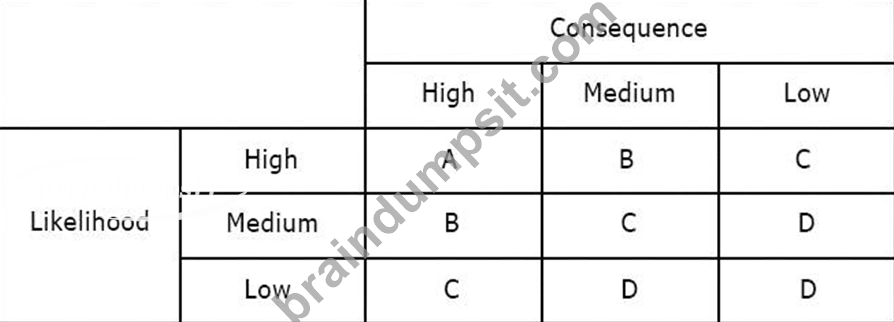
- A. Option B
- B. Option A
- C. Option D
- D. Option C
Answer: A
Explanation:
According to the ISA/IEC 62443 Cybersecurity Fundamentals, the risk matrix is a tool used to assess the risk of a particular event. The risk matrix is divided into three categories: likelihood, consequence, and risk. The likelihood is the probability that an event will occur, the consequence is the impact that the event will have, and the risk is the combination of the two. In this case, the risk of a medium likelihood event with high consequence is a high risk, as shown by the red cell in the matrix. References:
* ISA/IEC 62443 Cybersecurity Fundamentals
* [ISA/IEC 62443 Cybersecurity Certificate Program]
* [Cybersecurity Library]
* [Using the ISA/IEC 62443 Standard to Secure Your Control Systems]
NEW QUESTION # 85
An industrial control system requires strong protection against intentional violations using sophisticated means and moderate skills. According to the Security Level (SL) definitions, which SL should be targeted?
- A. SL 4
- B. SL 3
- C. SL 1
- D. SL 2
Answer: B
Explanation:
Security Levels (SLs) in the ISA/IEC 62443 framework define the degree of protection against specific threat actors. SL 3 is designed to protect against intentional violations using sophisticated means with moderate skills, moderate motivation, and IACS-specific knowledge.
"SL 3: Protection against intentional violation using sophisticated means with moderate skills, moderate motivation, and IACS-specific knowledge."
- ISA/IEC 62443-3-3:2013, Table 3 - Target Security Level definitions
This level is commonly applied to systems facing well-resourced threat actors such as organized cybercriminals or advanced persistent threats (APTs), where higher assurance is necessary than what SL1 or SL2 would provide.
References:
ISA/IEC 62443-3-3:2013 - Table 3
ISA/IEC 62443-1-1 - Security Level Definitions
ISA/IEC 62443-3-2 - Security level selection and justification guidance
NEW QUESTION # 86
Which of the following refers to internal rules that govern how an organization protects critical system resources?
Available Choices (select all choices that are correct)
- A. Formal guidance
- B. Legislation
- C. Security policy
D- Code of conduct
Answer: C
Explanation:
A security policy refers to internal rules that govern how an organization protects critical system resources, such as industrial control systems (ICS). A security policy defines the objectives, scope, roles, responsibilities, and requirements for securing the ICS environment, as well as the procedures and guidelines for implementing, monitoring, and enforcing the security measures. A security policy also establishes the baseline for assessing and managing the security risks to the ICS, and for ensuring compliance with relevant standards, regulations, and best practices. A security policy is a key component of the ICS security program, and it should be documented, communicated, and reviewed regularly.
The other choices are not correct because:
* A. Formal guidance. Formal guidance refers to external sources of information and recommendations that can help an organization improve its ICS security posture, such as standards, frameworks, guidelines, and best practices. Formal guidance is not an internal rule, but rather a reference that can be used to develop, implement, and evaluate the security policy and controls. For example, the ISA/IEC
62443 series of standards provide formal guidance on how to secure ICS from cyber threats1.
* B. Legislation. Legislation refers to external laws and regulations that impose legal obligations and penalties on an organization for its ICS security performance, such as the NERC CIP standards for the electric sector2, or the EU NIS Directive for critical infrastructure operators3. Legislation is not an internal rule, but rather a compliance requirement that must be met by the organization. Legislation may also influence the security policy and controls, as the organization needs to align its security objectives and practices with the legal expectations and consequences.
* D. Code of conduct. A code of conduct refers to a set of ethical principles and values that guide the
* behavior and decision-making of an organization and its employees, such as honesty, integrity, respect, and accountability. A code of conduct is not an internal rule for protecting critical system resources, but rather a general norm for conducting business and maintaining a positive reputation. A code of conduct may also support the security policy and culture, as it can foster a sense of responsibility and trust among the ICS stakeholders.
References:
* 1: ISA/IEC 62443 Standards to Secure Your Industrial Control System
* 2: NERC Critical Infrastructure Protection Standards
* 3: EU Network and Information Systems Directive
NEW QUESTION # 87
......
Online Questions - Valid Practice ISA-IEC-62443 Exam Dumps Test Questions: https://testking.braindumpsit.com/ISA-IEC-62443-latest-dumps.html