


PDF Download Free of 300-215 Valid Practice Test Questions
300-215 Test Engine files, 300-215 Dumps PDF
Cisco 300-215 exam is a highly respected certification that can help you stand out in the highly competitive field of cybersecurity. 300-215 exam is designed to test your knowledge and skills in conducting forensic analysis and incident response using Cisco technologies. Conducting Forensic Analysis & Incident Response Using Cisco Technologies for CyberOps certification is highly valued by employers, as it demonstrates that you have the knowledge and skills necessary to identify and respond to cybersecurity threats. If you are interested in pursuing a career in cybersecurity, then the Cisco 300-215 exam is a great way to get started.
Cisco 300-215: Conducting Forensic Analysis & Incident Response Using Cisco Technologies for CyberOps is an advanced-level certification exam that is designed to assess the candidate's knowledge and skills in conducting forensic analysis and incident response using Cisco technologies. 300-215 exam is intended for those who wish to pursue a career in cybersecurity and want to validate their skills and knowledge in the field.
NEW QUESTION # 54
An engineer is investigating a ticket from the accounting department in which a user discovered an unexpected application on their workstation. Several alerts are seen from the intrusion detection system of unknown outgoing internet traffic from this workstation. The engineer also notices a degraded processing capability, which complicates the analysis process. Which two actions should the engineer take? (Choose two.)
- A. Format the workstation drives.
- B. Replace the faulty CPU.
- C. Take an image of the workstation.
- D. Disconnect from the network.
- E. Restore to a system recovery point.
Answer: C,D
Explanation:
When suspicious activity is detected on a workstation, immediate steps need to be taken to preserve evidence and prevent further compromise:
* Disconnecting the system from the network (C)is crucial to stop potential exfiltration of data or ongoing communications with a command-and-control server. This isolation prevents further spread or damage while preserving the state of the compromised system for further investigation.
* Taking an image of the workstation (E)is part of the forensics acquisition process. It involves creating a bit-by-bit copy of the system's disk, which preserves all evidence in its current state. This allows for thorough forensic analysis without affecting the original evidence.
These steps align with the best practices outlined in the incident response and forensics processes (as described in theCyberOps Technologies (CBRFIR) 300-215 study guide). Specifically, in theIdentification and Containmentphases of the incident response cycle, it's emphasized that isolating the system and preserving evidence through imaging are critical to ensuring both containment of the threat and successful forensic investigation.
Reference:CyberOps Technologies (CBRFIR) 300-215 study guide, Chapter: Understanding the Security Incident Response Process, Identification and Containment Phases, page 102-104.
NEW QUESTION # 55
A security team is discussing lessons learned and suggesting process changes after a security breach incident.
During the incident, members of the security team failed to report the abnormal system activity due to a high project workload. Additionally, when the incident was identified, the response took six hours due to management being unavailable to provide the approvals needed. Which two steps will prevent these issues from occurring in the future? (Choose two.)
- A. Introduce a priority rating for incident response workloads.
- B. Automate security alert timeframes with escalation triggers.
- C. Conduct a risk audit of the incident response workflow.
- D. Provide phishing awareness training for the full security team.
- E. Create an executive team delegation plan.
Answer: A,E
Explanation:
According to theCyberOps Technologies (CBRFIR) 300-215 study guide, during thepost-incident activity phase, it is critical to analyze lessons learned and update processes to ensure quicker and more efficient response in the future. Specifically:
* Introducing a priority rating for incident response workloads(A) helps address the issue of team members being occupied with other tasks and unable to prioritize abnormal system activity. This ensures incidents are handled based on severity, not just workload.
* Creating an executive team delegation plan(D) addresses the issue of delays due to unavailability of management for approvals. It ensures alternative decision-makers are available for swift action.
These strategies are based on the NIST SP 800-61 Rev. 2 recommendations and are highlighted in the Cisco guide's post-incident activity phase (page 418), which emphasizeslessons learnedand how to reduce detection and response times for future incidents.
Reference:CyberOps Technologies (CBRFIR) 300-215 study guide, Chapter: Dealing with Incident Response, Post-Incident Activity, page 418.
NEW QUESTION # 56
Refer to the exhibit.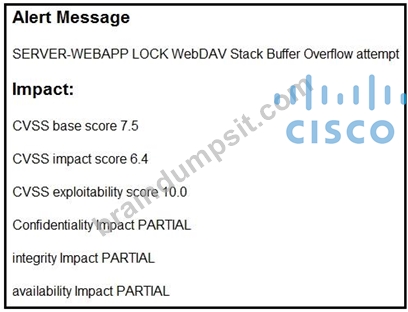
After a cyber attack, an engineer is analyzing an alert that was missed on the intrusion detection system. The attack exploited a vulnerability in a business-critical, web-based application and violated its availability.
Which two mitigation techniques should the engineer recommend? (Choose two.)
- A. heap-based security
- B. encapsulation
- C. NOP sled technique
- D. address space randomization
- E. data execution prevention
Answer: D,E
Explanation:
The alert indicates aWebDAV Stack Buffer Overflow, which is amemory corruptionattack targeting the stack, a common vector forremote code executionordenial-of-service (DoS).
To mitigate such exploits, two effective system-hardening techniques are:
* C. Address Space Layout Randomization (ASLR):Randomizes memory addresses used by system and application processes, making it difficult for attackers to predict where their malicious code will be executed.
* E. Data Execution Prevention (DEP):Prevents execution of code from non-executable memory regions such as the stack, thus stopping buffer overflow attacks from successfully executing payloads.
Both are well-established protections against stack-based buffer overflow attacks and are strongly recommended in the Cisco CyberOps Associate guide and general security best practices.
NEW QUESTION # 57 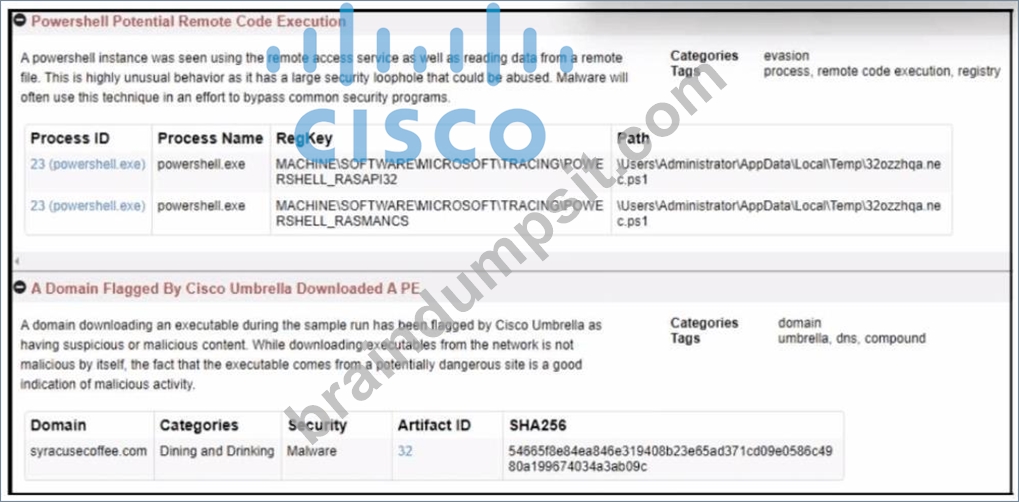
- A. Analyze the activity paths in Cisco Secure Malware Analytics.
- B. Evaluate the file activity in Cisco Umbrella.
- C. Evaluate the artifacts in Cisco Secure Malware Analytics.
- D. Analyze the registry activity section in Cisco Umbrella.
Answer: C
Explanation:
The correct next step in analyzing the malicious nature of the email is toevaluate the artifactsinCisco Secure Malware Analytics(formerly Threat Grid). This tool provides a comprehensive sandbox environment where behavioral indicators like file execution, registry access, and domain connections are logged and scored.
The exhibit shows:
* Remote PowerShell execution
* Executable download from a flagged domain
* SHA256 hash linked to malware
All these artifacts, as labeled in the Secure Malware Analytics output, arekey indicators of compromise, and analyzing them further can confirm whether the email was part of a malicious campaign.
Thus, the best action is:
A). Evaluate the artifacts in Cisco Secure Malware Analytics.
NEW QUESTION # 58
A security team received reports of users receiving emails linked to external or unknown URLs that are non- returnable and non-deliverable. The ISP also reported a 500% increase in the amount of ingress and egress email traffic received. After detecting the problem, the security team moves to the recovery phase in their incident response plan. Which two actions should be taken in the recovery phase of this incident? (Choose two.)
- A. remove vulnerabilities
- B. verify the breadth of the attack
- C. request packet capture
- D. collect logs
- E. scan hosts with updated signatures
Answer: A,E
NEW QUESTION # 59
Refer to the exhibit.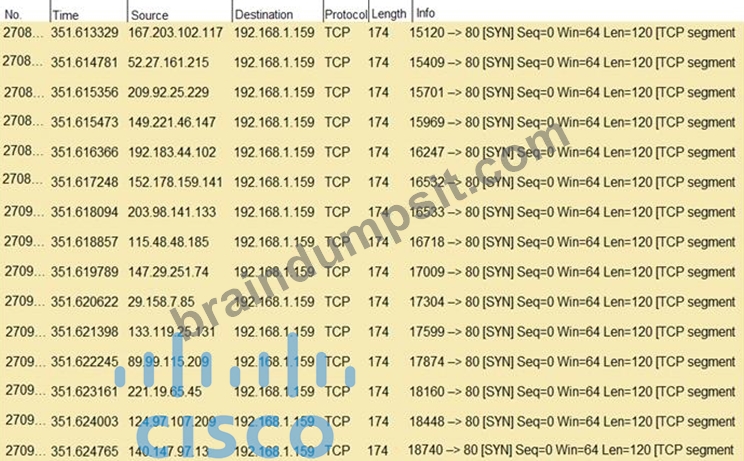
What should an engineer determine from this Wireshark capture of suspicious network traffic?
- A. There are signs of a DNS attack, and the engineer should hide the BIND version and restrict zone transfers as a countermeasure.
- B. There are signs of ARP spoofing, and the engineer should use Static ARP entries and IP address-to-MAC address mappings as a countermeasure.
- C. There are signs of a malformed packet attack, and the engineer should limit the packet size and set a threshold of bytes as a countermeasure.
- D. There are signs of SYN flood attack, and the engineer should increase the backlog and recycle the oldest half-open TCP connections.
Answer: D
NEW QUESTION # 60
Refer to the exhibit.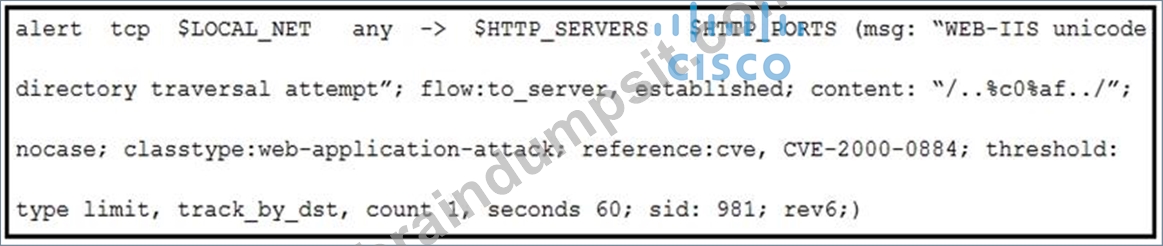
A company that uses only the Unix platform implemented an intrusion detection system. After the initial configuration, the number of alerts is overwhelming, and an engineer needs to analyze and classify the alerts.
The highest number of alerts were generated from the signature shown in the exhibit. Which classification should the engineer assign to this event?
- A. True Negative alert
- B. False Negative alert
- C. False Positive alert
- D. True Positive alert
Answer: C
Explanation:
The alert shown is based on aSnort rulefor aUnicode directory traversal attack against IIS web servers (Microsoft platform). The key detail here is the payload content"../..%c0%af../"which is a classic IIS-specific exploit related toCVE-2000-0884.
Since the company only usesUnix systems, they arenot vulnerableto this IIS-specific attack. Therefore, these alerts are triggered by irrelevant traffic or misapplied signatures, resulting inFalse Positives.
As defined in the Cisco CyberOps guide:
"False Positive: an alert is generated for traffic that is not actually malicious or relevant to the protected environment".
NEW QUESTION # 61 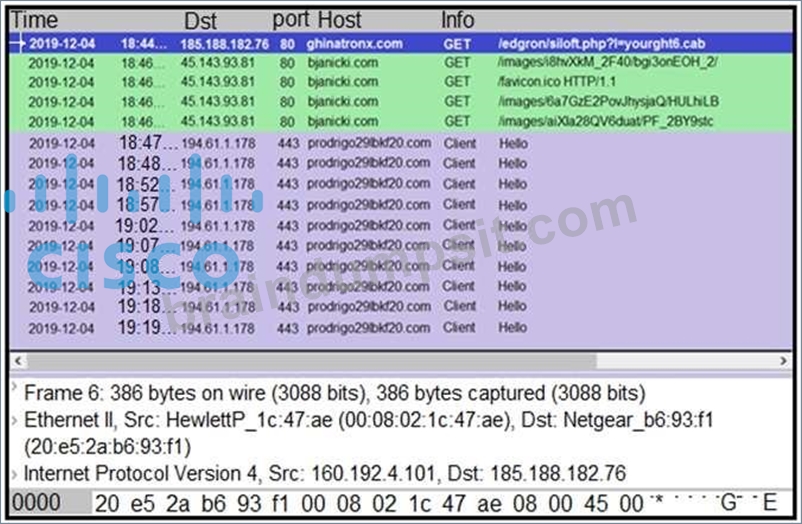
Refer to the exhibit. A network engineer is analyzing a Wireshark file to determine the HTTP request that caused the initial Ursnif banking Trojan binary to download. Which filter did the engineer apply to sort the Wireshark traffic logs?
- A. tcp.window_size ==0
- B. tls.handshake.type ==1
- C. tcp.port eq 25
- D. http.request.un matches
Answer: B
Explanation:
Explanation/Reference:
https://www.malware-traffic-analysis.net/2018/11/08/index.html
https://unit42.paloaltonetworks.com/wireshark-tutorial-examining-ursnif-infections/
NEW QUESTION # 62
Which magic byte indicates that an analyzed file is a pdf file?
- A. 255044462d
- B. 0a0ah4cg
- C. cGRmZmlsZQ
- D. 0
Answer: A
NEW QUESTION # 63
Refer to the exhibit.
- A. Base64 encoding
- B. metamorphic encoding
- C. ASCII85 encoding
- D. hex encoding
Answer: A
Explanation:
The string shown is long, alphanumeric, and includes both uppercase and lowercase letters with numbers- characteristics of Base64 encoding. This format is widely used to obfuscate payloads in malicious scripts, particularly in phishing or malware campaigns. Base64 encoding is also supported by Python and other platforms for data transformation.
-
NEW QUESTION # 64
A security team received an alert of suspicious activity on a user's Internet browser. The user's anti-virus software indicated that the file attempted to create a fake recycle bin folder and connect to an external IP address. Which two actions should be taken by the security analyst with the executable file for further analysis? (Choose two.)
- A. Analyze the Magic File type in Cisco Umbrella.
- B. Evaluate the process activity in Cisco Umbrella.
- C. Analyze the TCP/IP Streams in Cisco Secure Malware Analytics (Threat Grid).
- D. Network Exit Localization in Cisco Secure Malware Analytics (Threat Grid).
- E. Evaluate the behavioral indicators in Cisco Secure Malware Analytics (Threat Grid).
Answer: C,E
NEW QUESTION # 65
A network host is infected with malware by an attacker who uses the host to make calls for files and shuttle traffic to bots. This attack went undetected and resulted in a significant loss. The organization wants to ensure this does not happen in the future and needs a security solution that will generate alerts when command and control communication from an infected device is detected. Which network security solution should be recommended?
- A. Cisco Secure Email Gateway (ESA)
- B. Cisco Secure Firewall Threat Defense (Firepower)
- C. Cisco Secure Firewall ASA
- D. Cisco Secure Web Appliance (WSA)
Answer: B
NEW QUESTION # 66
Refer to the exhibit.
What is occurring?
- A. The request was redirected.
- B. The requested page was not found.
- C. An attacker attempted SQL injection.
- D. WAF detected code injection.
Answer: B
Explanation:
Comprehensive and Detailed Explanation:
The log entry contains the following key elements:
* The timestamp:(04/Jan/2022:20:18:06 +0000)
* HTTP method and URI:"GET /%60%60%60%60%60%60/ HTTP/2.0"
* HTTP status code:404
* User-Agent:Mozilla/5.0 ... Firefox/95.0
The status code404indicates that the requested resource was not found on the server. This is a standard HTTP response that signifies the server could not locate the requested URI (in this case, likely due to a malformed or invalid path/\`````/, where%60is the URL-encoded form of the backtick character "").
There is no clear evidence of SQL injection, WAF detection, or redirection in this log. The use of encoded backticks may suggest probing behavior, but the log does not show a definitive attack signature.
Therefore, the correct interpretation is:
D: The requested page was not found.
NEW QUESTION # 67
Refer to the exhibit.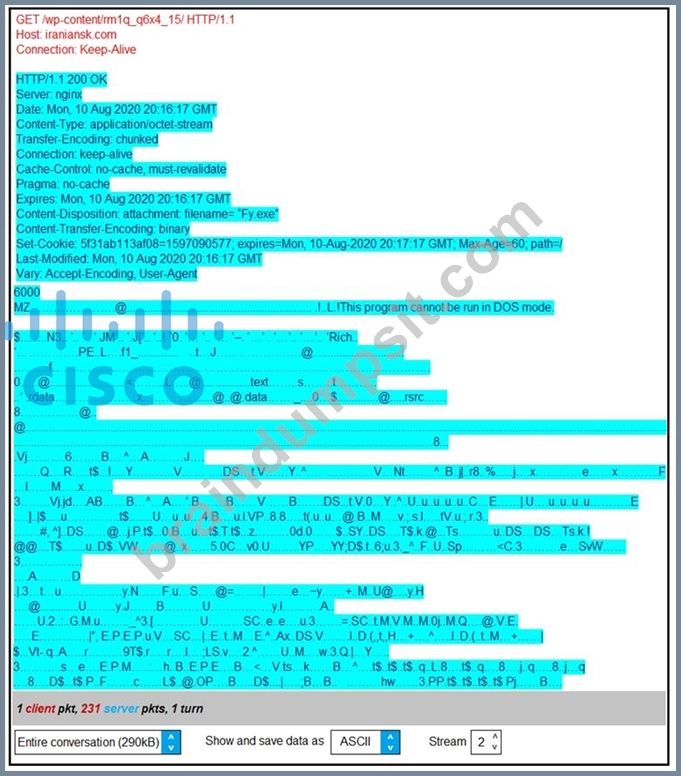
According to the Wireshark output, what are two indicators of compromise for detecting an Emotet malware download? (Choose two.)
- A. Server: nginx
- B. Domain name: iraniansk.com
- C. Hash value: 5f31ab113af08=1597090577
- D. Content-Type: application/octet-stream
- E. filename= "Fy.exe"
Answer: B,E
Explanation:
From the Wireshark capture:
* A (iraniansk.com): This domain isnot a known legitimate resourceand is hosting a suspicious file named "Fy.exe," strongly indicative of amalware distribution domain.
* D (Fy.exe): TheContent-Disposition: attachment; filename="Fy.exe"header explicitly signals abinary executabledownload, a key indicator in Emotet campaigns.
WhileContent-Type: application/octet-stream(E) is typical of binary data transfers, it isnot uniqueto malware and cannot by itself serve as a strong IoC. Thenginx server (B)andcookie/hash string (C)similarly do not uniquely indicate compromise.
NEW QUESTION # 68
Refer to the exhibit.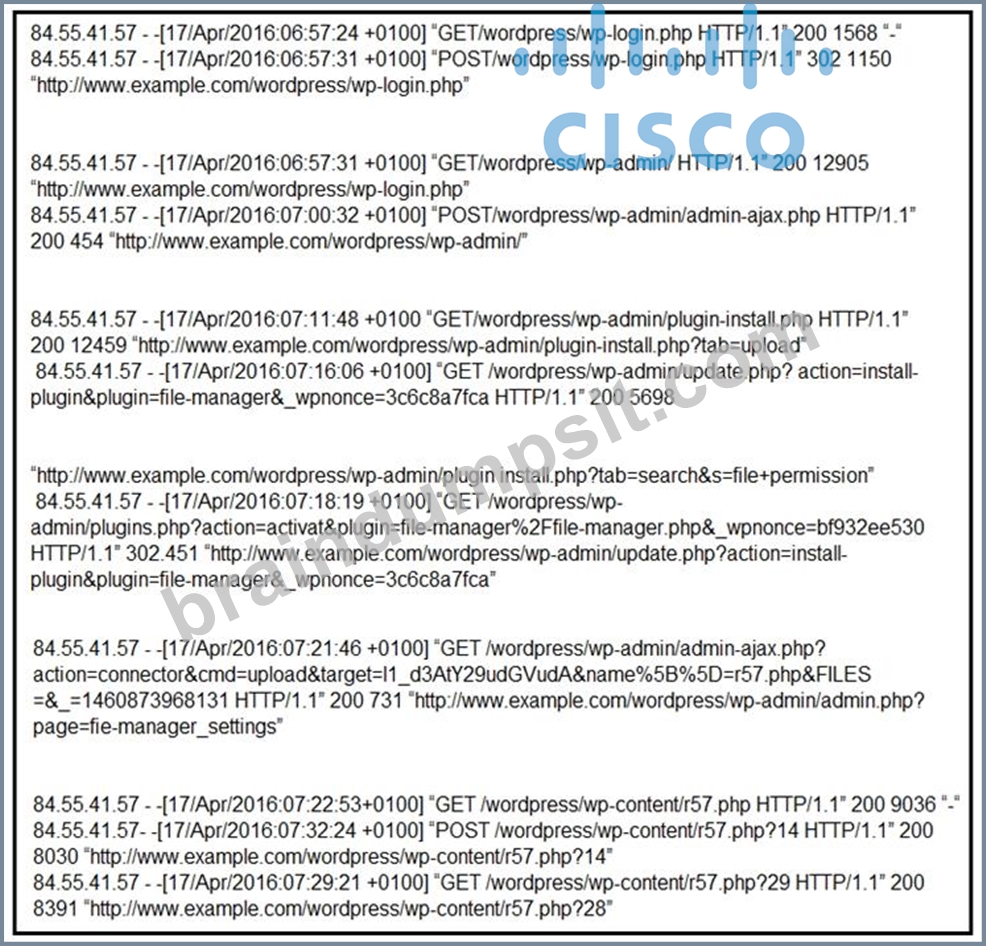
Which two determinations should be made about the attack from the Apache access logs? (Choose two.)
- A. The attacker used r57 exploit to elevate their privilege.
- B. The attacker logged on normally to WordPress admin page.
- C. The attacker performed a brute force attack against WordPress and used SQL injection against the backend database.
- D. The attacker used the WordPress file manager plugin to upload r57.php.
- E. The attacker uploaded the WordPress file manager trojan.
Answer: D,E
Explanation:
The Apache access logs in the exhibit show a sequence of HTTP requests and responses indicative of a malicious upload via WordPress:
* A POST to:
* /wp-admin/admin-ajax.php with parameters that include uploading r57.php (a known PHP web shell).
* The uploaded file name appears as r57.php in:# &name=%5B%5D=r57.php&FILES...
* There are plugin installation and activation attempts, specifically for:
* file-manager plugin:# plugin=file-manager&...
* Which is known to be vulnerable and exploited for file uploads.
* GET requests to:
* /wp-content/57.php and variations such as 57.php?28 - This suggests that r57.php was successfully uploaded and is being accessed.
These logs reveal that:
* D. The attacker used the WordPress file manager plugin to upload r57.php - confirmed by plugin activity and file uploads.
* B. The attacker uploaded the WordPress file manager trojan - as evidenced by the direct access to /wp- content/57.php (r57 shell variant).
Other options are invalid or speculative:
* A is correct in identifying r57 as a web shell, but the logs don't show privilege escalation.
* C mentions brute force and SQL injection, which are not indicated here.
* E assumes legitimate access - logs suggest exploitation, not standard login.
Reference:CyberOps Technologies (CBRFIR) 300-215 study guide, Chapter on "Analyzing HTTP and Apache Logs for Intrusion Behavior" and "Common CMS Exploits via Plugins and Upload
NEW QUESTION # 69
An analyst finds .xyz files of unknown origin that are large and undetected by antivirus. What action should be taken next?
- A. Move the files to a less secure network segment for analysis.
- B. Rename the file extensions to .txt to enable easier opening and review by team members.
- C. Isolate the files and perform a deeper heuristic analysis to detect potential unknown malware or data exfiltration payloads.
- D. Delete the files immediately to prevent potential risks.
Answer: C
Explanation:
The safest and most effective approach is to isolate the files and subject them to heuristic and behavioral analysis. This can reveal obfuscated malware or unauthorized data storage techniques, even if signature-based antivirus fails to flag them.
NEW QUESTION # 70
Refer to the exhibit.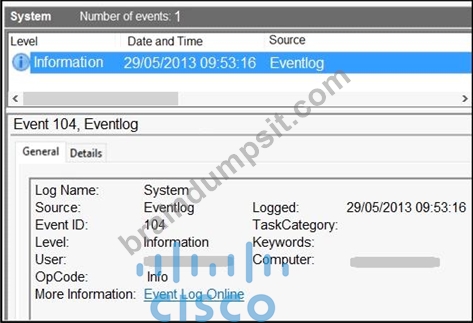
An employee notices unexpected changes and setting modifications on their workstation and creates an incident ticket. A support specialist checks processes and services but does not identify anything suspicious. The ticket was escalated to an analyst who reviewed this event log and also discovered that the workstation had multiple large data dumps on network shares. What should be determined from this information?
- A. log tampering
- B. reconnaissance attack
- C. brute-force attack
- D. data obfuscation
Answer: B
NEW QUESTION # 71
An investigator is analyzing an attack in which malicious files were loaded on the network and were undetected. Several of the images received during the attack include repetitive patterns. Which anti-forensic technique was used?
- A. spoofing
- B. tunneling
- C. steganography
- D. obfuscation
Answer: C
NEW QUESTION # 72
What is an antiforensic technique to cover a digital footprint?
- A. privilege escalation
- B. authorization
- C. obfuscation
- D. authentication
Answer: C
Explanation:
Antiforensic techniques are methods attackers use to cover their tracks. According to the Cisco CyberOps curriculum, "obfuscation" refers to techniques such as encoding, encrypting, or otherwise disguising commands, payloads, or scripts to avoid detection and analysis. This is a standard antiforensic tactic used to prevent attribution and hinder forensic investigation.
Options like privilege escalation and authentication are part of attack vectors or access control and not antiforensic methods.
NEW QUESTION # 73
What is the steganography anti-forensics technique?
- A. hiding a section of a malicious file in unused areas of a file
- B. concealing malicious files in ordinary or unsuspecting places
- C. sending malicious files over a public network by encapsulation
- D. changing the file header of a malicious file to another file type
Answer: B
Explanation:
Steganography is the anti-forensics technique of hiding malicious content within seemingly innocent files, such as image, audio, or video files. The goal is to conceal data or code in a way that avoids suspicion and detection, thereby making traditional security inspection tools ineffective unless they are explicitly designed to detect hidden data within media files.
Steganography differs from encryption because it does not simply make data unreadable; it hides the existence of the data itself. It is commonly used in cyber operations to hide command-and-control instructions or to exfiltrate sensitive information in covert ways.
Reference:CyberOps Technologies (CBRFIR) 300-215 study guide, Chapter on Evasion and Obfuscation Techniques, Anti-Forensics, Steganography Section.
NEW QUESTION # 74
A security team received reports of users receiving emails linked to external or unknown URLs that are non-returnable and non-deliverable. The ISP also reported a 500% increase in the amount of ingress and egress email traffic received. After detecting the problem, the security team moves to the recovery phase in their incident response plan. Which two actions should be taken in the recovery phase of this incident?
(Choose two.)
- A. remove vulnerabilities
- B. verify the breadth of the attack
- C. request packet capture
- D. collect logs
- E. scan hosts with updated signatures
Answer: A,E
NEW QUESTION # 75
......
Cisco 300-215 exam is intended for cybersecurity professionals who are responsible for the security of critical IT infrastructure, such as network administrators, security analysts, and incident responders. It is also suitable for professionals who are interested in enhancing their knowledge and skills in the field of cybersecurity.
Pass Your CyberOps Professional 300-215 Exam on Sep 06, 2025 with 118 Questions: https://testking.braindumpsit.com/300-215-latest-dumps.html