


Get Microsoft AZ-304 Dumps Questions [2022] To Gain Brilliant Result
AZ-304 dumps - BraindumpsIT - 100% Passing Guarantee
NEW QUESTION 19
A company named Contoso, Ltd- has an Azure Active Directory {Azure AD) tenant that uses the Basic license.
You plan to deploy two applications to Azure. The applications have the requirements shown in the following table.
Which authentication strategy should you recommend for each application? To answer, drag the appropriate authentication strategies to the correct applications. Each authentication strategy may be used once, more than once, or not at all. You may need to drag the split bar between panes or scroll to view content.
NOTE: Each correct selection is worth one point.
Answer:
Explanation:
Reference:
https://docs.microsoft.com/en-us/azure/active-directory-b2c/active-directory-b2c-reference-mfa
https://docs.microsoft.com/en-us/azure/active-directory/develop/v2-overview
NEW QUESTION 20
You plan to deploy an application named App1 that will run on five Azure virtual machines. Additional virtual machines will be deployed later to run App1.
You need to recommend a solution to meet the following requirements for the virtual machines that will run App1:
* Ensure that the virtual machines can authenticate to Azure Active Directory (Azure AD) to gain access to
* an Azure key vault, Azure Logic Apps instances, and an Azure SQL database.
* Avoid assigning new roles and permissions for Azure services when you deploy additional virtual machines.
* Avoid storing secrets and certificates on the virtual machines.
Which type of identity should you include in the recommendation?
- A. a user-assigned managed identity
- B. a service principal that is configured to use a certificate
- C. a service principal that is configured to use a client secret
- D. a system-assigned managed identity
Answer: A
Explanation:
Explanation
Managed identities for Azure resources is a feature of Azure Active Directory.
User-assigned managed identity can be shared. The same user-assigned managed identity can be associated with more than one Azure resource.
Reference:
https://docs.microsoft.com/en-us/azure/active-directory/managed-identities-azure-resources/overview
NEW QUESTION 21
You are building an application that will run in a virtual machine (VM). The application will use Azure Managed Identity.
The application uses Azure Key Vault, Azure SQL Database, and Azure Cosmos DB.
You need to ensure the application can use secure credentials to access these services.
Which authentication method should you recommend? To answer, select the appropriate options in the answer area.
NOTE: Each correct selection is worth one point.
Answer:
Explanation:
Reference:
https://docs.microsoft.com/en-us/azure/active-directory/managed-identities-azure-resources/overview
NEW QUESTION 22
You have an Azure subscription.
You need to recommend a solution to provide developers with the ability to provision Azure virtual machines. The solution must meet the following requirements:
Only allow the creation of the virtual machines in specific regions.
Only allow the creation of specific sizes of virtual machines.
What should include in the recommendation?
- A. role-based access control (RBAC)
- B. Azure Resource Manager templates
- C. Azure Policy
- D. conditional access policies
Answer: C
Explanation:
https://docs.microsoft.com/en-us/azure/governance/policy/tutorials/create-and-manage
https://docs.microsoft.com/en-us/azure/cloud-adoption-framework/manage/azure-server-management/common-policies#restrict-vm-size
NEW QUESTION 23
You are planning an Azure solution that will host production databases for a high-performance application.
The solution will include the following components:
* Two virtual machines that will run Microsoft SQL Server 2016, will be deployed to different data centers in the same Azure region, and will be part of an Always On availability group.
* SQL Server data that will be backed up by using the Automated Backup feature of the SQL Server IaaS Agent Extension (SQLIaaSExtension) You identify the storage priorities for various data types as shown in the following table.
Which storage type should you recommend for each data type? To answer, drag the appropriate storage types to the correct data types. Each storage type may be used once, more than once, or not at all. You may need to drag the split bar between panes or scroll to view content.
NOTE: Each correct selection is worth one point.
Answer:
Explanation:
Explanation
NEW QUESTION 24
You manage an on-premises network and Azure virtual networks.
You need to create a secure connection over a private network between the on-premises network and the Azure virtual networks. The connection must offer a redundant pair of cross connections to provide high availability.
What should you recommend?
- A. Azure Load Balancer
- B. VPN Gateway
- C. virtual network peering
- D. ExpressRoute
Answer: D
Explanation:
Topic 2, Fabrikam, inc Case Study A
Overview:
Existing Environment
Fabrikam, Inc. is an engineering company that has offices throughout Europe. The company has a main office in London and three branch offices in Amsterdam Berlin, and Rome.
Active Directory Environment:
The network contains two Active Directory forests named corp.fabnkam.com and rd.fabrikam.com. There are no trust relationships between the forests. Corp.fabrikam.com is a production forest that contains identities used for internal user and computer authentication. Rd.fabrikam.com is used by the research and development (R&D) department only.
Network Infrastructure:
Each office contains at least one domain controller from the corp.fabrikam.com domain. The main office contains all the domain controllers for the rd.fabrikam.com forest.
All the offices have a high-speed connection to the Internet.
An existing application named WebApp1 is hosted in the data center of the London office. WebApp1 is used by customers to place and track orders. WebApp1 has a web tier that uses Microsoft Internet Information Services (IIS) and a database tier that runs Microsoft SQL Server 2016. The web tier and the database tier are deployed to virtual machines that run on Hyper-V.
The IT department currently uses a separate Hyper-V environment to test updates to WebApp1.
Fabrikam purchases all Microsoft licenses through a Microsoft Enterprise Agreement that includes Software Assurance.
Problem Statement:
The use of Web App1 is unpredictable. At peak times, users often report delays. Al other times, many resources for WebApp1 are underutilized.
Requirements:
Planned Changes:
Fabrikam plans to move most of its production workloads to Azure during the next few years.
As one of its first projects, the company plans to establish a hybrid identity model, facilitating an upcoming Microsoft Office 365 deployment All R&D operations will remain on-premises.
Fabrikam plans to migrate the production and test instances of WebApp1 to Azure.
Technical Requirements:
Fabrikam identifies the following technical requirements:
* Web site content must be easily updated from a single point.
* User input must be minimized when provisioning new app instances.
* Whenever possible, existing on premises licenses must be used to reduce cost.
* Users must always authenticate by using their corp.fabrikam.com UPN identity.
* Any new deployments to Azure must be redundant in case an Azure region fails.
* Whenever possible, solutions must be deployed to Azure by using platform as a service (PaaS).
* An email distribution group named IT Support must be notified of any issues relating to the directory synchronization services.
* Directory synchronization between Azure Active Directory (Azure AD) and corp.fabhkam.com must not be affected by a link failure between Azure and the on premises network.
Database Requirements:
Fabrikam identifies the following database requirements:
* Database metrics for the production instance of WebApp1 must be available for analysis so that database administrators can optimize the performance settings.
* To avoid disrupting customer access, database downtime must be minimized when databases are migrated.
* Database backups must be retained for a minimum of seven years to meet compliance requirement Security Requirements:
Fabrikam identifies the following security requirements:
*Company information including policies, templates, and data must be inaccessible to anyone outside the company
*Users on the on-premises network must be able to authenticate to corp.fabrikam.com if an Internet link fails.
*Administrators must be able authenticate to the Azure portal by using their corp.fabrikam.com credentials.
*All administrative access to the Azure portal must be secured by using multi-factor authentication.
*The testing of WebApp1 updates must not be visible to anyone outside the company.
NEW QUESTION 25
You need to design an Azure policy that will implement the following functionality:
* For new resources, assign tags and values that match the tags and values of the resource group to which the resources are deployed.
* For existing resources, identify whether the tags and values match the tags and values of the resource group that contains the resources.
* For any non-compliant resources, trigger auto-generated remediation tasks to create missing tags and values.
The solution must use the principle of least privilege.
What should you include in the design? To answer, select the appropriate options in the answer area.
NOTE: Each correct selection is worth one point.
Answer:
Explanation:
NEW QUESTION 26
You need to recommend a disaster recovery solution for the back-end tier of the payment processing system.
What should you include in the recommendation?
- A. an auto-failover group
- B. Always On Failover Cluster Instances
- C. Azure Site Recovery
- D. active geo-replication
Answer: A
Explanation:
References:
https://docs.microsoft.com/en-us/azure/sql-database/sql-database-auto-failover-group
NEW QUESTION 27
You plan to create an Azure Cosmos DB account that uses the SQL API. The account will contain data added by a web application. The web application will send data daily.
You need to recommend a notification solution that meets the following requirements:
* Sends email notifications when data is received from the web application
* Minimizes compute cost
What should you include in the recommendation?
- A. Deploy an Azure logic app that has a webhook configured to use a SendGrid action.
- B. Deploy a function app that is configured to use the Consumption plan and a SendGrid binding.
- C. Deploy an Azure logic app that has a SendGrid connector configured to use an Azure Cosmos DB action.
- D. Deploy a function app that is configured to use the Consumption plan and an Azure Event Hubs binding.
Answer: B
Explanation:
Explanation
You can send email by using SendGrid bindings in Azure Functions. Azure Functions supports an output binding for SendGrid.
Note: When you're using the Consumption plan, instances of the Azure Functions host are dynamically added and removed based on the number of incoming events.
Reference:
https://docs.microsoft.com/en-us/azure/azure-functions/functions-bindings-sendgrid
https://docs.microsoft.com/en-us/azure/azure-functions/functions-scale#consumption-plan
NEW QUESTION 28
You are designing a network connectivity strategy for a new Azure subscription. You identify the following requirements:
The Azure virtual machines on a subnet named Subnet1 must be accessible only from the computers in your London office.
Engineers require access to the Azure virtual machine on a subnet named Subnet2 over the Internet on a specific TCP/IP management port.
The Azure virtual machines in the West Europe Azure region must be able to communicate on all ports to the Azure virtual machines in the North Europe Azure region.
You need to recommend which components must be used to meet the requirements. The solution must minimize costs and administrative effort whenever possible.
What should you include in the recommendation? To answer, drag the appropriate components to the correct requirements. Each component may be used once, more than once, or not at all. You may need to drag the split bar between panes or scroll to view content.
NOTE: Each correct selection is worth one point.
Answer:
Explanation:
NEW QUESTION 29
You plan to deploy an Azure web app named Appl that will use Azure Active Directory (Azure AD) authentication.
App1 will be accessed from the internet by the users at your company. All the users have computers that run Windows 10 and are joined to Azure AD.
You need to recommend a solution to ensure that the users can connect to App1 without being prompted for authentication and can access App1 only from company-owned computers.
What should you recommend for each requirement? To answer, select the appropriate options in the answer area.
NOTE: Each correct selection is worth one point.
Answer:
Explanation:
Reference:
https://codingcanvas.com/using-azure-active-directory-authentication-in-your-web-application/
https://docs.microsoft.com/en-us/azure/active-directory/conditional-access/overview
NEW QUESTION 30
You need to recommend a solution for data of the historical transaction query system.
What should you include in the recommendation? To answer, Select the appropriate or options in the answer area.
NOTE: Each correct selection is worth one point
Answer:
Explanation:
Explanation
NEW QUESTION 31
You are designing an order processing system in Azure that will contain the Azure resources shown in the following table.
The order processing system will have the following transaction flow:
* A customer will place an order by using App1.
* When the order is received, App1 will generate a message to check for product availability at vendor 1 and vendor 2.
* An integration component will process the message, and then trigger either Function1 or Function2 depending on the type of order.
* Once a vendor confirms the product availability, a status message for App1 will be generated by Function1 or Function2.
* All the steps of the transaction will be logged to storage1.
Which type of resource should you recommend for the integration component?
D18912E1457D5D1DDCBD40AB3BF70D5D
Which type of resource should you recommend for the integration component?
- A. an Azure Data Factory pipeline
- B. an Azure Service Bus queue
- C. an Azure Event Hubs capture
- D. an Azure Event Grid domain
Answer: A
Explanation:
Explanation
A data factory can have one or more pipelines. A pipeline is a logical grouping of activities that together perform a task.
The activities in a pipeline define actions to perform on your data.
Data Factory has three groupings of activities: data movement activities, data transformation activities, and control activities.
Azure Functions is now integrated with Azure Data Factory, allowing you to run an Azure function as a step in your data factory pipelines.
Reference:
https://docs.microsoft.com/en-us/azure/data-factory/concepts-pipelines-activities
NEW QUESTION 32
You have an Azure blueprint named BP1.
The properties of BP1 are shown in the Properties exhibit. (Click the Properties tab.)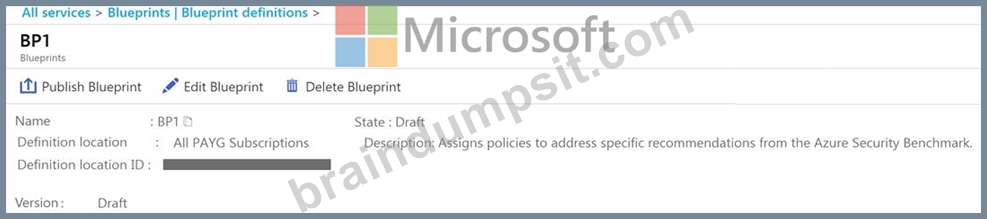
The basic configuration of the blueprint is shown in the Basics exhibit. (Click the Basics tab.)
The artifacts attached to BP1 are shown in the Artifacts exhibit. (Click the Artifacts tab.)
For each of the following statements, select Yes if the statement is true. Otherwise, select No.
NOTE: Each correct selection is worth one point.
Answer:
Explanation:
Reference:
https://docs.microsoft.com/en-us/azure/governance/blueprints/overview
NEW QUESTION 33
You have an Azure subscription that contains resources in three Azure regions.
You need to implement Azure Key Vault to meet the following requirements:
D18912E1457D5D1DDCBD40AB3BF70D5D
In the event of a regional outage, all keys must be readable.
All the resources in the subscription must be able to access Key Vault.
The number of Key Vault resources to be deployed and managed must be minimized.
How many instances of Key Vault should you implement?
- A. 0
- B. 1
- C. 2
- D. 3
Answer: D
Explanation:
Explanation
https://github.com/uglide/azure-content/blob/master/articles/key-vault/key-vault-disaster-recovery-guidance.md
NEW QUESTION 34
Your company uses Microsoft System Center Service Manager on its on-premises network.
You plan to deploy several services to Azure.
You need to recommend a solution to push Azure service hearth alerts to Service Manager. What should you include in the recommendation?
- A. Azure Notification Hubs
- B. Azure Event Hubs
- C. IT Service Management Connector (ITSM)
- D. Application Insights Connector
Answer: C
NEW QUESTION 35
You have an Azure subscription. The subscription has a blob container that contains multiple blobs. Ten users in the finance department of your company plan to access the blobs during the month of April. You need to recommend a solution to enable access to the blobs during the month of April only. Which security solution should you include in the recommendation?
- A. certificates
- B. conditional access policies
- C. access keys
- D. shared access signatures (SAS)
Answer: B
NEW QUESTION 36
You configure OAuth2 authorization in API Management as shown in the exhibit.
Use the drop-domain to select the answer choice that completes each statement based on the information presented in the graphic.
NOTE: Each correct selection is worth one point.
Answer:
Explanation:
Explanation
Box 1: Web applications
The Authorization Code Grant Type is used by both web apps and native apps to get an access token after a user authorizes an app.
Note: The Authorization Code grant type is used by confidential and public clients to exchange an authorization code for an access token.
After the user returns to the client via the redirect URL, the application will get the authorization code from the URL and use it to request an access token.
Answers:
Not Headless device authentication:
A headless system is a computer that operates without a monitor, graphical user interface (GUI) or peripheral devices, such as keyboard and mouse.
Headless computers are usually embedded systems in various devices or servers in multi-server data center environments. Industrial machines, automobiles, medical equipment, cameras, household appliances, airplanes, vending machines and toys are among the myriad possible hosts of embedded systems.
Box 2: Client Credentials
How to include additional client data
In case you need to store additional details about a client that don't fit into the standard parameter set the custom data parameter comes to help:
POST /c2id/clients HTTP/1.1
Host: demo.c2id.com
Content-Type: application/json
Authorization: Bearer ztucZS1ZyFKgh0tUEruUtiSTXhnexmd6
{
"redirect_uris" : [ "https://myapp.example.com/callback" ],
"data" : { "reg_type" : "3rd-party",
"approved" : true,
"author_id" : 792440 }
}
The data parameter permits arbitrary content packaged in a JSON object. To set it you will need the master registration token or a one-time access token with a client-reg:data scope.
Reference:
https://developer.okta.com/blog/2018/04/10/oauth-authorization-code-grant-type
https://connect2id.com/products/server/docs/guides/client-registration
NEW QUESTION 37
You are reviewing the budget for Azure Storage as shown in the exhibit (Click the Exhibit tab.) All the virtual machines in the Azure subscription use Premium storage.
Use the drop-down menus to select the answer choice that completes each statement based on the information presented in the graphic.
NOTE: correct selection is worth one point.
Answer:
Explanation:
NEW QUESTION 38
You deploy several Azure SQL Database instances.
You plan to configure the Diagnostics settings on the databases as shown in the following exhibit.
Use the drop-down menus to select the answer choice that completes each statement based on the information presented in the graphic.
NOTE: Each correct selection is worth one point.
Answer:
Explanation:
Explanation
In the exhibit, the SQLInsights data is configured to be stored in Azure Log Analytics for 90 days. However, the question is asking for the "maximum" amount of time that the data can be stored which is 730 days.
NEW QUESTION 39
You need to recommend a solution to meet the database retention requirement. What should you recommend?
- A. Configure geo replication of the database.
- B. Configure Azure Site Recovery.
- C. Configure a long-term retention policy for the database.
- D. Use automatic Azure SQL Database backups.
Answer: C
Explanation:
Topic 1, Fabrikam, inc Case Study A
Overview:
Existing Environment
Fabrikam, Inc. is an engineering company that has offices throughout Europe. The company has a main office in London and three branch offices in Amsterdam Berlin, and Rome.
Active Directory Environment:
The network contains two Active Directory forests named corp.fabnkam.com and rd.fabrikam.com. There are no trust relationships between the forests. Corp.fabrikam.com is a production forest that contains identities used for internal user and computer authentication. Rd.fabrikam.com is used by the research and development (R&D) department only.
Network Infrastructure:
Each office contains at least one domain controller from the corp.fabrikam.com domain. The main office contains all the domain controllers for the rd.fabrikam.com forest.
All the offices have a high-speed connection to the Internet.
An existing application named WebApp1 is hosted in the data center of the London office. WebApp1 is used by customers to place and track orders. WebApp1 has a web tier that uses Microsoft Internet Information Services (IIS) and a database tier that runs Microsoft SQL Server 2016. The web tier and the database tier are deployed to virtual machines that run on Hyper-V.
The IT department currently uses a separate Hyper-V environment to test updates to WebApp1.
Fabrikam purchases all Microsoft licenses through a Microsoft Enterprise Agreement that includes Segment Software Assurance.
Problem Statement:
The use of Web App1 is unpredictable. At peak times, users often report delays. Al other times, many resources for WebApp1 are underutilized.
Requirements:
Planned Changes:
Fabrikam plans to move most of its production workloads to Azure during the next few years.
As one of its first projects, the company plans to establish a hybrid identity model, facilitating an upcoming Microsoft Office 365 deployment All R&D operations will remain on-premises.
Fabrikam plans to migrate the production and test instances of WebApp1 to Azure.
Technical Requirements:
Fabrikam identifies the following technical requirements:
* Web site content must be easily updated from a single point.
* User input must be minimized when provisioning new app instances.
* Whenever possible, existing on premises licenses must be used to reduce cost.
* Users must always authenticate by using their corp.fabrikam.com UPN identity.
* Any new deployments to Azure must be redundant in case an Azure region fails.
* Whenever possible, solutions must be deployed to Azure by using platform as a service (PaaS).
* An email distribution group named IT Support must be notified of any issues relating to the directory synchronization services.
* Directory synchronization between Azure Active Directory (Azure AD) and corp.fabhkam.com must not be affected by a link failure between Azure and the on premises network.
Database Requirements:
Fabrikam identifies the following database requirements:
* Database metrics for the production instance of WebApp1 must be available for analysis so that database administrators can optimize the performance settings.
* To avoid disrupting customer access, database downtime must be minimized when databases are migrated.
* Database backups must be retained for a minimum of seven years to meet compliance requirement Security Requirements:
Fabrikam identifies the following security requirements:
*Company information including policies, templates, and data must be inaccessible to anyone outside the company
*Users on the on-premises network must be able to authenticate to corp.fabrikam.com if an Internet link fails. *Administrators must be able authenticate to the Azure portal by using their corp.fabrikam.com credentials.
*All administrative access to the Azure portal must be secured by using multi-factor authentication.
*The testing of WebApp1 updates must not be visible to anyone outside the company.
NEW QUESTION 40
Your company develops a web service that is deployed to at, Azure virtual machine named VM1 the web service allows an API to access real- time data from VM1. The current virtual machine deployment is shown in the Deployment exhibit. (Click the Deployment tab).
The chief technology officer (CTO) sends you the following email message: "Our developers have deployed the web service to a virtual machine named WL Testing has shown that the API is accessible from VM1 and VM? Our partners must be able to connect to the API over the Internet Partners will me this data in applications that they develop:
You deploy an Azure API Management service. The relevant API Management configuration is shown in the API ambit. (Click the API tab).
For each of the following statements, select. Yes, if the statement is true. Otherwise. select No.
NOTE: Each correct selection is worth one point.
Answer:
Explanation:
NEW QUESTION 41
You have an Azure App Service Web App that includes Azure Blob storage and an Azure SQL Database instance. The application is instrumented by using the Application Insights SDK.
You need to design a monitoring solution for the web app.
Which Azure monitoring services should you use? To answer, select the appropriate Azure monitoring services in the answer area.
NOTE: Each correct selection is worth one point.
Answer:
Explanation:
NEW QUESTION 42
You have an Azure subscription.
You need to deploy an Azure Kubernetes Service (AKS) solution that will use Linux nodes. The solution must meet the following requirements:
* Minimize the time it takes to provision compute resources during scale-out operations.
* Support autoscaling of Linux containers.
* Minimize administrative effort.
Which scaling option should you recommend?
- A. AKS virtual nodes
- B. cluster autoscaler
- C. Virtual Kubelet
- D. horizontal pod autoscaler
Answer: B
Explanation:
Explanation
About the cluster autoscaler.
AKS clusters can scale in one of two ways:
* The cluster autoscaler watches for pods that can't be scheduled on nodes because of resource constraints.
The cluster then automatically increases the number of nodes.
* The horizontal pod autoscaler uses the Metrics Server in a Kubernetes cluster to monitor the resource demand of pods.
Reference:
https://docs.microsoft.com/en-us/azure/aks/cluster-autoscaler
NEW QUESTION 43
......
Get 100% Passing Success With True AZ-304 Exam: https://testking.braindumpsit.com/AZ-304-latest-dumps.html